
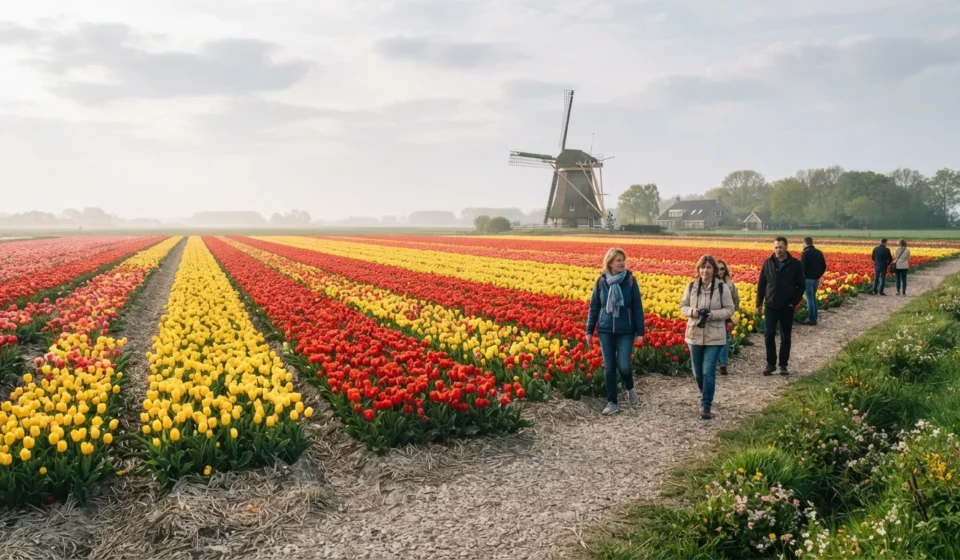
The best places to see tulips include Keukenhof Gardens in the Netherlands, the Skagit Valley in Washington State, Ottawa’s Commissioners Park in Canada, and Emirgan Park in Istanbul. Each offers a different scale of bloom, from manicured show gardens to working commercial fields that stretch to the horizon.
Tulip season runs on a tight window, usually four to six weeks depending on the region and how warm the spring turns out. Timing the trip matters as much as picking the destination, since a week too early or too late can mean buds instead of full color.
Keukenhof Gardens, Netherlands
Keukenhof, near Lisse in South Holland, is the most visited tulip garden in the world. It opens for about eight weeks each spring, typically from mid-March to mid-May, and draws well over a million visitors during that window.
The garden itself is planted with millions of bulbs across roughly 32 hectares, arranged in themed beds, flower mosaics, and a few show pavilions. Keukenhof sits inside the Bollenstreek, the bulb-growing region that supplies a large share of the world’s tulip bulbs, so the surrounding countryside is worth a slow drive even after the garden closes for the day.
Tickets sell out on weekends during peak bloom (usually mid-April), so booking a timed entry a few weeks ahead is worth the extra planning. Renting a bike in Lisse and riding out into the open fields around the garden is one of the better ways to see color that isn’t cropped into a formal display.
Skagit Valley, Washington
The Skagit Valley, about an hour north of Seattle, hosts the largest tulip fields in the United States. The Skagit Valley Tulip Festival runs through most of April, and the exact peak shifts year to year based on temperature, so growers post daily bloom updates during the season.
RoozenGaarde and Tulip Town are the two main display gardens, both surrounded by acres of working farmland planted in wide color blocks. Unlike Keukenhof’s curated beds, this is a working agricultural region, and the flowers are grown commercially for bulb export as well as for visitors.

Weekday mornings are noticeably quieter than weekends, and the light is better for photos before the fog burns off. Parking fills fast at both display gardens on Saturdays, so arriving before 9 a.m. avoids the worst of it.
Ottawa, Canada
Ottawa holds the Canadian Tulip Festival every May, built around a gift of 100,000 bulbs sent from the Netherlands in 1945 as thanks for sheltering the Dutch royal family during the Second World War. The city has kept the tradition going, and the National Capital Commission now plants close to a million bulbs across the city each year.
Commissioners Park, next to Dow’s Lake, holds the largest single display and is free to walk through. Major’s Hill Park and the grounds around several federal buildings also carry smaller plantings, so a self-guided walk between two or three sites covers most of the color without needing a car.
The festival typically runs through the first half of May, though a cool spring can push bloom into the middle of the month. Checking the festival’s own bloom reports closer to the date is more reliable than going by the calendar alone.
Istanbul, Turkey
Tulips originated in Central Asia and were cultivated in the Ottoman Empire long before they reached the Netherlands in the sixteenth century. Istanbul leans into that history with the Istanbul Tulip Festival, held every April, when the city plants millions of bulbs in parks across both the European and Asian sides.
Emirgan Park, on the European shore of the Bosphorus, is the main site and is planted with tulips in traditional Ottoman patterns rather than the block colors seen in Dutch fields. Gulhane Park, next to Topkapi Palace, and Sultanahmet Square offer a more central option for visitors who are already sightseeing in the old city.

Because the display is spread across dozens of parks rather than concentrated in one garden, it is possible to see tulips as a backdrop to normal city life rather than as a separate ticketed attraction. Most of the plantings in city parks are free to visit.
Wooden Shoe Tulip Farm, Oregon
The Wooden Shoe Tulip Farm, south of Portland in Woodburn, runs its own festival every spring, usually from late March into early May depending on weather. The farm plants around 40 acres in tulips and offers wagon rides out into the fields, which is a useful option for visitors who want a wide view without a long walk.
Oregon’s tulip season tends to start a couple of weeks earlier than Skagit Valley’s, since the Willamette Valley warms up sooner. Checking both farms’ bloom updates before booking flights makes sense if the trip depends on catching peak color at either location.
The farm allows cut-your-own tulips during the festival, which is a detail most large public gardens do not offer. Weekday visits are generally quieter than the weekend wine and food events the farm runs alongside the bloom.
When to Plan a Tulip Trip
Tulip bloom dates move every year based on winter temperatures and how quickly spring warms up, so no single date works across regions or even across years in the same location. A safer approach is to pick a destination first, then watch that location’s own bloom reports starting about a month out.
Most of the destinations above post weekly or daily updates once the season gets close. Building in a flexible day or two, rather than a single fixed date, is the most reliable way to avoid arriving before the fields open or after the petals have dropped.
1. Rough Bloom Windows by Region
- Netherlands (Keukenhof and the Bollenstreek): mid-March to mid-May, peak usually mid-April
- Skagit Valley, Washington: all of April, peak varies by 1 to 2 weeks year to year
- Ottawa, Canada: early to mid-May
- Istanbul, Turkey: April
- Willamette Valley, Oregon: late March into April
Tips for Visiting Tulip Fields
A few practical habits make any of these trips go more smoothly, regardless of which destination is on the list.
- Arrive early. Fields and gardens are quieter, cooler, and better lit for photos before mid-morning crowds arrive.
- Stay off the rows. Commercial fields are working farms, and walking between the planted rows damages the crop and is often against posted rules.
- Check bloom reports weekly once the season opens, since forecasts made months ahead are rarely accurate.
- Bring layers. Early spring mornings in most of these regions are cold even when the afternoon warms up.
- Book timed tickets for Keukenhof and the larger festivals in advance, especially for weekend dates in peak bloom weeks.
Tulips do not hold their color for long once cut or once the weather turns warm, so a short, well-timed visit tends to beat a longer trip planned too far in advance.