

To become a travel nurse, you need a nursing degree, an RN license, and one to two years of bedside experience. Then you sign with a staffing agency that places you on short-term contracts, usually 13 weeks, at hospitals across the country. Most nurses finish the full path in three to six years depending on which degree they choose.
This guide covers each step in order. You will also learn how travel nurse pay is really structured, the tax rule that decides whether your stipends stay tax-free, and how to pick housing and agencies without rookie mistakes.
The short version:
- Earn a nursing degree (ADN or BSN)
- Pass the NCLEX-RN and get your RN license
- Gain one to two years of bedside experience
- Get your certifications (BLS, ACLS, plus specialty certs)
- Choose a travel nursing agency
- Apply for your first contract
What Does A Travel Nurse Actually Do
A travel nurse is a registered nurse who works temporary contracts through a staffing agency instead of holding a permanent hospital job. Assignments usually run 13 weeks, though some last a few weeks and others stretch past a year. You might spend one quarter in a busy ICU in Texas and the next in a rural ER in Montana.
Hospitals hire travel nurses to cover seasonal surges, staff shortages, and leave gaps. In return, you earn higher pay than most staff roles, collect housing and meal stipends, and build experience across different units and cities. The tradeoff is constant motion. You learn new charting systems, new teams, and new cities every few months, which is exactly why staying fit while traveling matters when your shifts run 12 hours.
How Long Does It Take To Become A Travel Nurse
The timeline depends on your degree path. Here is the honest math.
| Path | Schooling | Bedside experience | Total |
|---|---|---|---|
| ADN route | ~2 years | 1-2 years | 3-4 years |
| BSN route | ~4 years | 1-2 years | 5-6 years |
The ADN route gets you working sooner. The BSN route takes longer but opens more doors, especially for competitive specialty units. Either way, plan on the experience years. Agencies rarely make exceptions, and the nurses who skip this step struggle the most on their first contracts.
Step 1: Earn Your Nursing Degree
Every travel nurse starts as a registered nurse, and every RN needs formal training from an accredited program first. You have two main options.
ADN Or BSN: Which Path Fits You
An Associate Degree in Nursing (ADN) takes about two years and costs less. It gets you licensed and earning faster, which makes it a solid choice if you want to start traveling sooner rather than later.
A Bachelor of Science in Nursing (BSN) takes four years. It makes you more competitive from day one. An American Association of Colleges of Nursing survey found that more than 70% of healthcare employers prefer BSN-prepared hires, and BSN graduates pass the NCLEX on the first attempt at higher rates (82.32% vs 77.91% for ADN graduates, per NCSBN data reported by nursingeducation.org). If you already hold an ADN, an RN-to-BSN bridge program lets you upgrade later without starting over.
Pick the ADN if speed and cost matter most. Pick the BSN if you are aiming for ICU, ER, or other high-demand units where competition for contracts is stiffest.
Step 2: Pass The NCLEX-RN And Get Licensed
After graduation, you sit for the NCLEX-RN, the standardized exam every RN candidate in the US must pass. It is computer-based, runs 85 to 150 questions, and can take up to five hours. Questions cover safe care environments, health promotion, psychosocial integrity, and physiological integrity.
Once you pass, you apply for licensure through your home state’s board of nursing. Expect background checks and fingerprinting in most states. This step is not optional. Agencies verify your license before placing you anywhere.
Why The Nurse Licensure Compact Matters
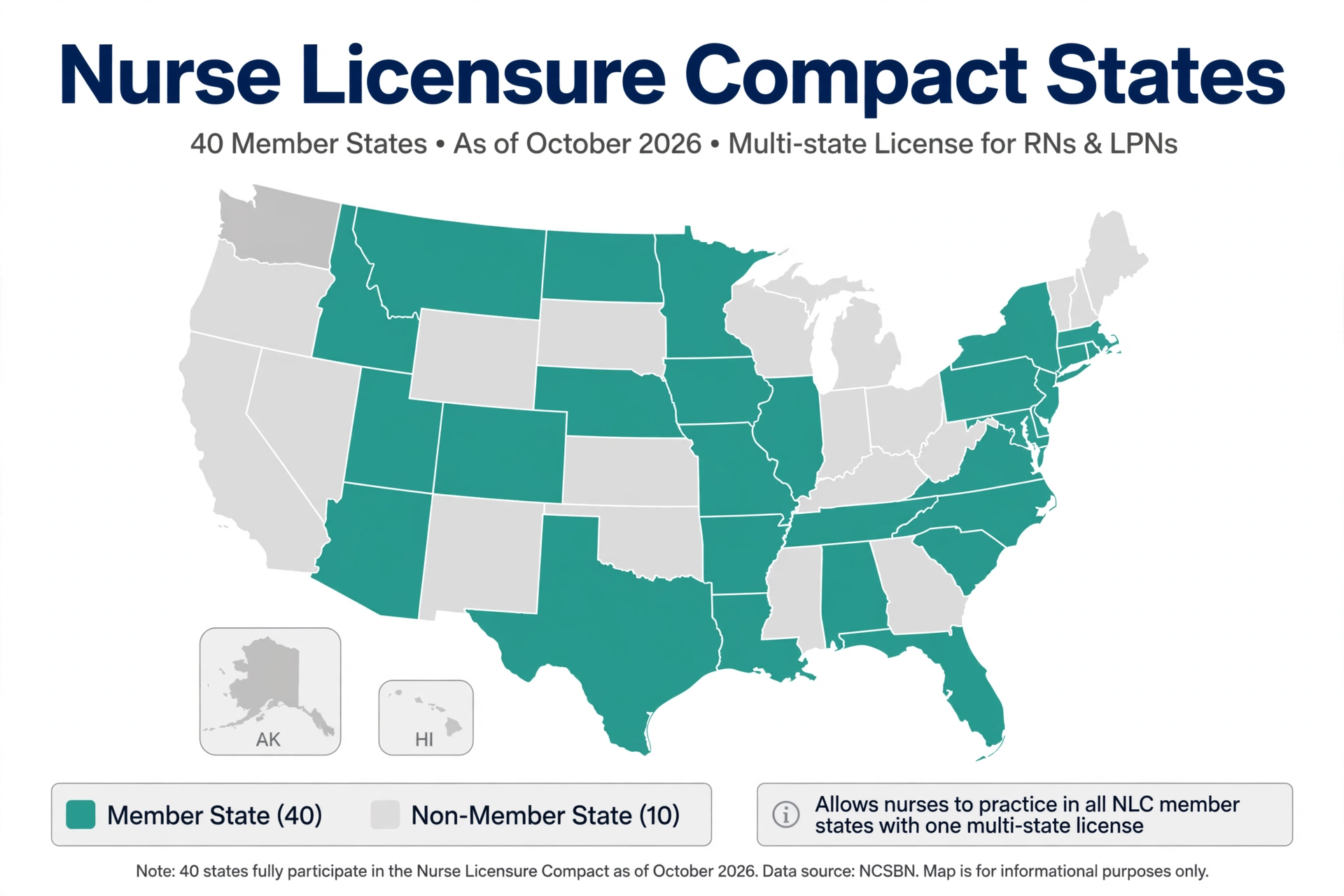
The Nurse Licensure Compact (NLC) lets RNs with a multistate license practice in other member states without applying for a separate license each time. As of July 2026, 43 jurisdictions have enacted the compact and 40 have fully implemented it, according to nurse.org. California is still the famous holdout and requires its own state license.
If your home state is in the compact, get the multistate license. It removes a huge paperwork burden. If your target state is not in the compact, start that separate application early. Some states, like California, can take up to six months to process a license, and some agencies will reimburse the fees if you ask.
Step 3: Gain One To Two Years Of Bedside Experience
This is the step new grads underestimate most. Travel nursing agencies almost never hire straight out of school. Most require one to two years of hospital-based experience in your specialty before they review your application.
The reason is simple. Travel nurses get very little orientation, sometimes just a few shifts, before they are expected to carry a full patient load. Agencies need proof you can function on your own from week one. Use these years to build real judgment: work a busy unit, volunteer for tough assignments, and get comfortable making fast decisions under pressure.
Which Specialties Get The Most Offers
ICU, emergency room, labor and delivery, med-surg, telemetry, and operating room nurses see the most assignment offers and the best pay. Hospitals feel shortages hardest in these units, so travelers there have real bargaining power. If you are still choosing a specialty, picking one of these shortens your job search later. Note that you can only take contracts in units where you have real experience. A med-surg background will not qualify you for an ICU contract.
Step 4: Get The Right Certifications
Beyond your RN license, agencies expect Basic Life Support (BLS) and Advanced Cardiovascular Life Support (ACLS). You can earn both through the American Heart Association or the American Red Cross. Specialty units ask for more: Pediatric Advanced Life Support (PALS) for children’s units, Trauma Nursing Core Course (TNCC) for the ER, or CCRN for critical care.
Keep every certification current before you start applying. A lapsed card can delay your start date by weeks while a hospital credentialing office waits on paperwork. Specialty certifications like CCRN will not just check a box. They make you stand out to recruiters and can push your pay higher.
Step 5: Choose A Travel Nursing Agency
Once you meet the experience and certification bar, it is time to pick an agency. This choice matters more than most new travelers expect. Your agency negotiates your pay, writes your contracts, arranges your housing, and is your lifeline when something goes wrong at 2 a.m. in a strange city.
Talk to travel nurses already working in your hospital. Ask which agencies they use, how support held up during a rough assignment, and whether the pay matched what was promised. Then talk to two or three agencies yourself before committing. It is completely normal to work with multiple agencies, and some facilities only take travelers from specific agencies with exclusive contracts.
Questions To Ask Any Recruiter
Ask these before you sign anything:
- How is the pay package split between taxable wages and tax-free stipends?
- How many hours per week are guaranteed, and what happens if the hospital cancels shifts?
- What is the cancellation policy if I need to leave or the facility ends the contract early?
- Do you provide housing or a stipend, and which GSA per diem rate is the stipend based on?
- Who exactly do I call after hours if something goes wrong on assignment?
- Can I read the full contract before I commit to anything?
A good recruiter answers all of these directly. A vague recruiter is telling you everything you need to know. And when a recruiter makes a verbal promise, about time off or anything else, get it in the written contract. If it is not in the contract, the facility does not have to honor it.
Step 6: Apply For Your First Assignment
With an agency on board, you will browse open contracts filtered by specialty, location, pay, and length. When one fits, your recruiter submits your profile. If the facility is interested, expect a short remote interview, often just 15 to 20 minutes with the unit manager.
If you get the offer, your recruiter handles logistics: housing, travel dates, and orientation scheduling. Most first-time travelers do better starting with a shorter 8 to 13 week contract close-ish to home. It lets you test the lifestyle before committing to a cross-country move. When you start comparing locations, browsing the best cities to visit in the USA doubles as contract-location research. Keep your IDs, licenses, and certifications organized and backed up while you move, and know what to do if you lose your passport before you actually need it.
What Your First Week Really Looks Like
Expect a short orientation, sometimes only two or three shifts. Day one, learn the charting system, because everything else depends on it. Introduce yourself to the charge nurse and ask who to go to with questions. Find the supply room, the code cart, and the break room. Ask questions early and often. Asking on day two looks smart. Guessing on day two looks dangerous.
How Travel Nurse Pay Really Works
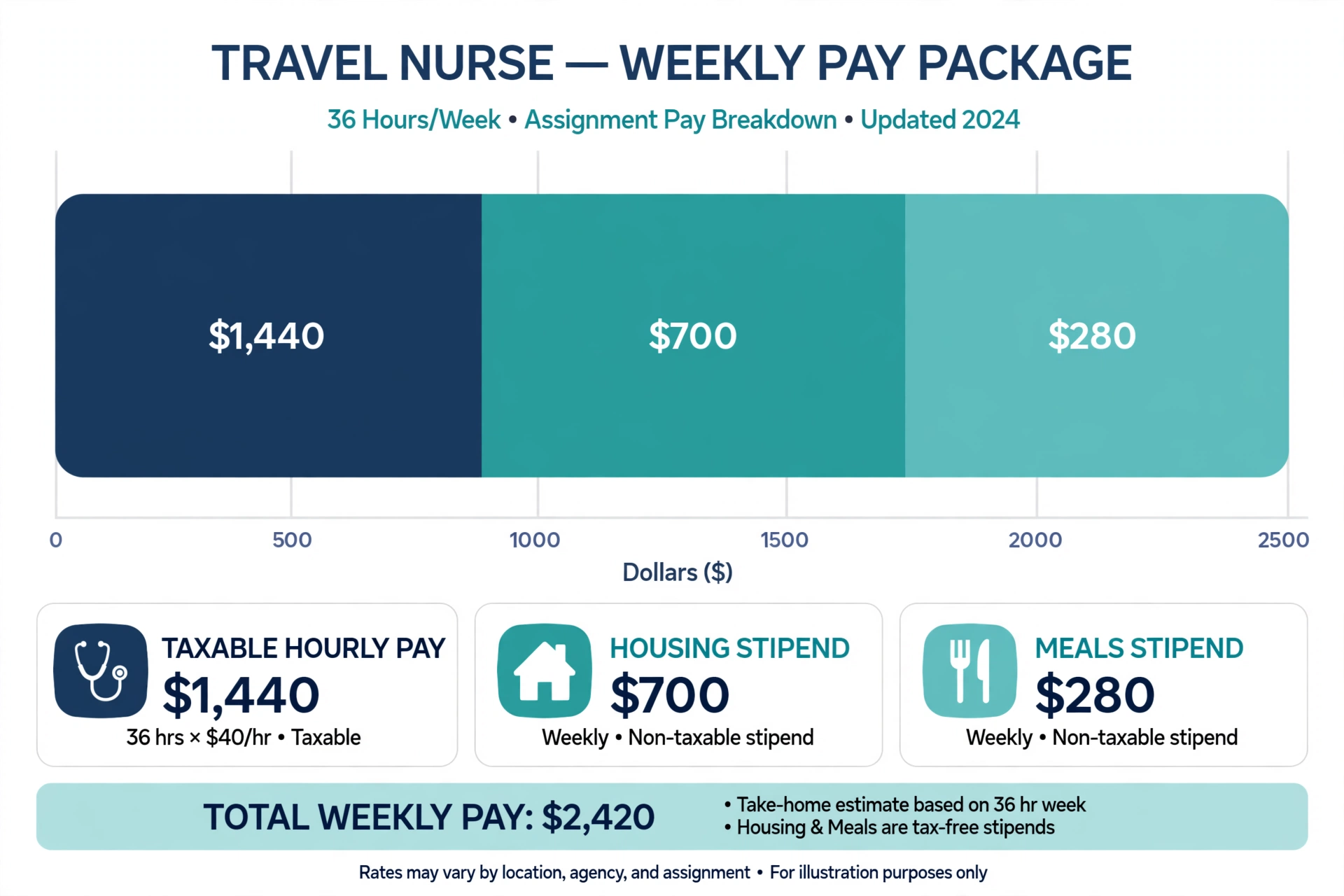
This is the part most guides skip, and it is the part that determines your actual income. Travel nurse pay is a blended package, not a single hourly number. It has two parts.
Taxable wages: your hourly base pay, taxed like normal income. This is often lower than a staff nurse’s hourly rate, which surprises people.
Tax-free stipends: weekly allowances for housing and for meals and incidentals (M&IE). These are not taxed as long as you qualify under the IRS tax home rule (more on that below). Stipend amounts generally follow federal GSA per diem rates for your assignment area, though agencies are not required to pay the maximum.
Here is why the split matters. A contract at $30 per hour with $2,000 per week in stipends usually beats a contract at $45 per hour with $500 per week in stipends, because so much of the first package arrives tax-free. Always compare the total effective weekly pay, not the headline hourly rate. Run the numbers on every offer your recruiter sends.
What Travel Nurses Earn Right Now
| Source | Figure | Date |
|---|---|---|
| Vivian Health (US average, ~299,000 active jobs) | $2,209/week | Oct 2026 |
| ZipRecruiter (travel RN average) | $48.62/hr, ~$101,132/yr | 2026 |
| BLS (median, all RNs, for context) | $97,550/yr | May 2025 |
Advertised weekly rates run higher for in-demand specialties. Recent listings show cath lab contracts advertised up to about $4,300 per week and ICU and OR contracts up to about $3,600 per week, per nurse.org’s job data. Your actual offer depends on specialty, location, shift, and how urgently the facility needs coverage.
Beyond base pay, most contracts include completion bonuses, and many agencies offer sign-on bonuses, referral bonuses, health insurance, and 401(k) plans. Ask your recruiter which of these are on the table. They are negotiable more often than new travelers realize.
The Tax Home Rule, Explained Simply
Those tax-free stipends come with a condition from the IRS. To receive them tax-free, you must maintain a legitimate tax home and be traveling away from it. Here is what that means in plain terms.
You need a real home base. The IRS defines your tax home as the general area of your main place of work or business. For most travel nurses, it is the permanent home they return to between contracts.
You must duplicate your living expenses. You pay to maintain your home base (rent or mortgage, utilities) while also paying for lodging at your assignment. This is the core test. Paper ties like a driver’s license alone do not count without real ongoing housing costs.
The assignment must be temporary. If a job is realistically expected to last more than 12 months at one location, the IRS can treat it as indefinite, and the stipends become taxable.
If you do not maintain a tax home, the IRS classifies you as an itinerant worker. That means your tax home is wherever you happen to be working, and every stipend dollar becomes fully taxable income. You may also owe back taxes and penalties if audited. One more thing: the “50-mile rule” you will hear about is an agency guideline, not IRS law. The IRS test is whether you are duplicating expenses away from home, not a fixed distance.
Tax law here is genuinely tricky, and mistakes are expensive. Talk to a tax professional who works with travel nurses before your first contract, not after.
Housing On The Road: Take The Stipend Or Let The Agency Book It
Every contract gives you a housing choice, and it is a real financial decision.
Take the stipend if you want control and the chance to pocket the difference. You find your own furnished place, often a month-to-month rental or an extended-stay hotel, and anything left over from the stipend stays with you tax-free. The tradeoff is the work: you handle the search, the lease, and the risk if the place falls through. For longer stays, compare extended-stay rates against hotel discounts for travel workers before you commit.
Take agency-provided housing if you want simplicity. The agency books a furnished place and handles problems. The tradeoff is choice and often money, since agency housing usually costs you more of the total package than finding your own place would.
Either way, a few rules help. Book month-to-month whenever you can, because contracts can end early or extend without much warning. Arrive a day before orientation so a housing surprise does not make you late. Join travel nurse housing groups for your assignment city, but never wire money to a landlord you have not verified. And remember that tourist season inflates rents fast in popular cities, so time your contracts with that in mind.

Is Travel Nursing Right For You
Travel nursing suits people who adapt fast, handle frequent moves without much drama, and can walk into an unfamiliar unit and get productive within days. The upside is real: higher effective pay, new cities every few months, and clinical experience that would take staff nurses years to accumulate.
The tradeoffs are real too. You will sort out housing several times a year, live with less job stability than a permanent role, and feel homesick now and then. Licenses, certifications, and tax paperwork follow you everywhere. Many nurses treat travel nursing as a multi-year chapter rather than a permanent career, then settle into a staff role once they find a city or specialty they love. And yes, you can go back. Travel experience tends to make nurses more attractive to hiring managers, not less.
One honest note: this path is built for registered nurses. If healthcare is not your field but the travel lifestyle appeals to you, look at how to become a Disney travel agent instead. Different career, same suitcase.
Your Next Move
Learning how to become a travel nurse is the easy part. Doing it takes a degree, a license, a couple of years at the bedside, and the willingness to live out of a suitcase for a while. Start with Step 1 if you are still in school. If you are already an experienced RN, your fastest move is to get your certifications current, check your compact license status, and start talking to two or three recruiters this month. Compare their pay packages line by line, protect your tax home from day one, and take a shorter first contract while you learn the ropes. The nurses who do well at this are not the ones with perfect plans. They are the ones who stay organized, ask blunt questions, and adapt fast.