Colombia’s top tourist attractions span Cartagena’s colonial old town, the graffiti-covered hillsides of Medellin, the coffee farms around Salento, and the Caribbean beaches of Tayrona National Park. Each region delivers a different version of the country, so the right itinerary depends on whether you want colonial history, mountain scenery, or open water.
Colombia covers more ground than France and Spain combined, with three Andean mountain ranges running through the middle, a Pacific coast, a Caribbean coast, and a share of the Amazon basin in the south. That geography is why a single trip rarely covers more than one or two regions properly.
Cartagena’s Walled City
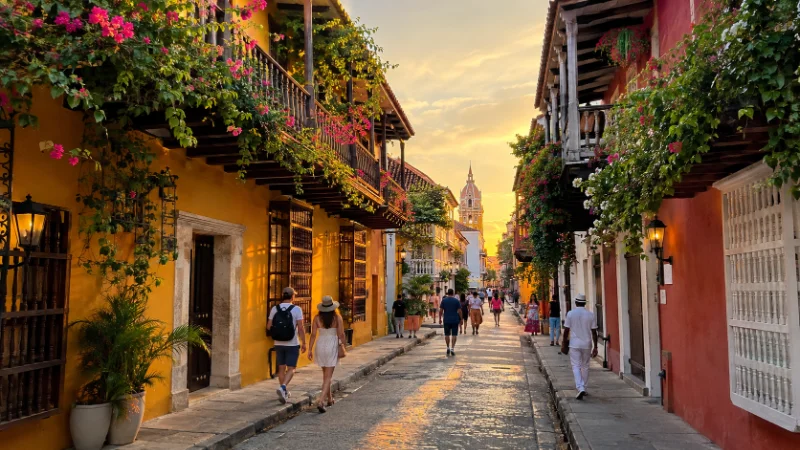
Cartagena’s Ciudad Amurallada is the attraction most people picture when they think of Colombia. Spanish colonial buildings painted in mustard yellow, terracotta, and turquoise line narrow streets built in the 1500s to defend against pirate raids. The stone wall itself, Las Murallas, still wraps around the old town and is free to walk at sunset with the Caribbean on one side.
Inside the walls, the Plaza de los Coches and Plaza Santo Domingo fill up with street vendors selling fresh fruit and cold coconut lemonade. Getsemani, the neighborhood just outside the main wall, has become known for its street art and a younger, less touristy nightlife scene. Most visitors spend two to three days here before heading to the beaches or the coffee region.
The Castillo San Felipe de Barajas, a fortress built by the Spanish starting in 1657, sits on a hill just outside the old town and is one of the largest colonial fortifications built in the Americas. Boats leave daily from the old town’s harbor for the Rosario Islands, a cluster of small coral islands about an hour offshore with calmer water than the mainland beaches.
Bogota, the Capital at 8,600 Feet
Bogota sits high in the Andes, which keeps daytime temperatures mild year-round even though the city is close to the equator. La Candelaria, the historic center, holds the Gold Museum, home to more than 34,000 pieces of pre-Hispanic gold work, along with dozens of murals and cafes tucked into old republican-era buildings.
Monserrate, the mountain overlooking the city, is reachable by cable car or funicular and gives a full view of Bogota’s skyline against the Andes. On a clear day, you can see well past the city limits. The Botero Museum, also in La Candelaria, is free to enter and holds work donated directly by the artist, including his signature oversized figures.
The Sunday Ciclovia, when roughly 75 miles of main roads close to cars and open to cyclists and runners, is one of the largest recurring car-free events in the world and gives visitors an easy way to see several neighborhoods in one morning.
Medellin and Comuna 13
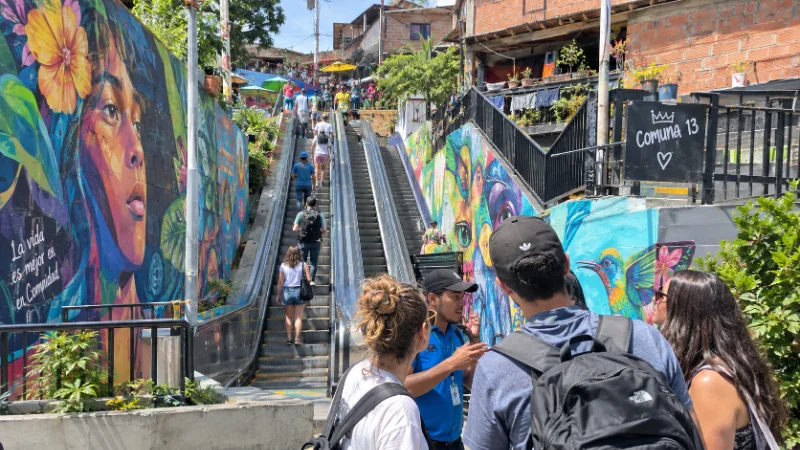
Medellin has rebuilt its reputation over the past two decades, and Comuna 13 is the clearest example of that shift. The neighborhood was one of the most dangerous parts of the city in the 1990s. Today it’s covered in murals painted by local artists, connected by a series of outdoor escalators that locals use for daily transport and that tourists ride while stopping to look at the art and hear guides explain the history behind specific pieces.
Medellin’s climate, close to 70 degrees Fahrenheit most of the year, has earned it the nickname “City of Eternal Spring.” The Metrocable system, originally built to connect poorer hillside neighborhoods to the city center, doubles as a scenic ride over the barrios and is worth taking even without a specific destination in mind.
El Poblado, the neighborhood most visitors base themselves in, holds most of the city’s restaurants and hotels, while Laureles offers a quieter, more residential alternative. Parque Arvi, reached by a second cable car line that climbs above the city into the surrounding forest, has hiking trails and a small artisan market that runs on weekends.
The Coffee Region: Salento and Cocora Valley
The Zona Cafetera, centered around towns like Salento, Filandia, and Manizales, produces a large share of Colombia’s coffee exports. Salento’s main street is lined with single-story buildings painted in bright primary colors, and most coffee farms in the surrounding hills, known as fincas, offer walking tours that end with a cup brewed from beans picked that same week.
Cocora Valley, a short jeep ride from Salento, is home to the wax palm, Colombia’s national tree and the tallest palm species in the world. Some of the palms in the valley reach past 200 feet. The main hiking loop through Cocora takes four to six hours and passes through cloud forest before opening into the wide valley where the palms stand in clusters against the mountains.
The jeeps that run the route, known as Willys, are restored World War II-era vehicles still used as the main form of transport around Salento.
Tayrona National Park
Tayrona sits on Colombia’s Caribbean coast near Santa Marta, where the Sierra Nevada mountains drop almost directly into the sea. The park protects beaches like Cabo San Juan and Playa Cristal, both reachable only by a hike of one to two hours through dry tropical forest, since no roads run to the coastline itself.
Camping and hammock rentals are available at Cabo San Juan for travelers who want to stay overnight rather than do a day trip from Santa Marta or Palomino. Howler monkeys and toucans are common sights along the trail. The park closes periodically throughout the year to allow the land to rest, so checking the current schedule before planning a visit matters.
The Lost City trek, a separate multi-day hike to the Ciudad Perdida ruins in the same mountain range, is often paired with a Tayrona visit by travelers with extra time, though it requires a licensed guide and four to five days on the trail.
Guatape and El Peñol
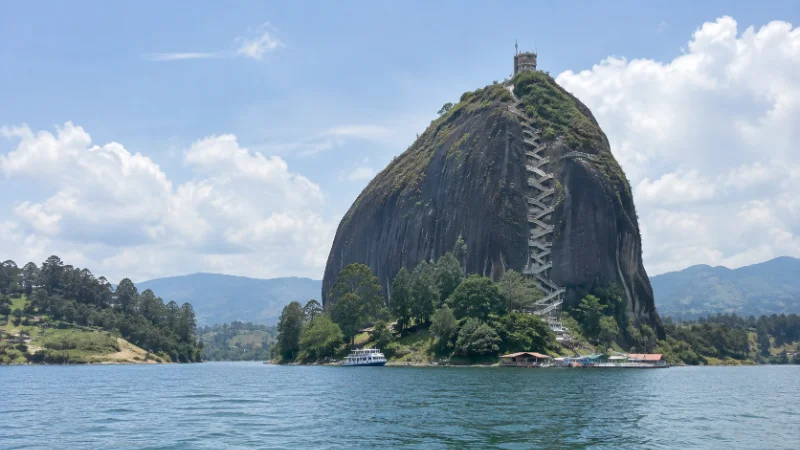
Guatape, a two-hour drive from Medellin, is known for two things: a rock formation called El Peñol and a lakeside town covered in painted relief panels called zocalos. El Peñol rises 650 feet above the surrounding reservoir, and a staircase of 649 steps built into the rock leads to a viewing platform at the top.
From the summit, the view shows the flooded valley below, dotted with small islands and inlets created when the reservoir was built in the 1970s. Guatape’s town square is a short drive from the rock and makes for an easy stop before or after the climb, with restaurants serving trout pulled from the lake that morning.
The zocalos covering the base of nearly every building in town were originally a way for families to mark their trade or identity, and many still tell a specific story about the household behind them.
San Andrés and Providencia
San Andres, a small island roughly 400 miles off Colombia’s mainland but only 150 miles from Nicaragua, sits in a sea locals describe as having “seven colors” because of how the shallow reef floor shifts the water’s shade from turquoise to deep blue. Johnny Cay and Acuario are the two most visited snorkeling spots, both a short boat ride from the main town.
Providencia, San Andres’s quieter sister island, has far fewer hotels and almost no large resorts, which keeps it closer to how San Andres looked decades ago. Getting there requires a small propeller plane or a slower ferry, and the extra effort is usually why visitors describe it as their favorite stop on a Colombia trip.
Both islands are part of a UNESCO-designated biosphere reserve. Locals speak a Creole English alongside Spanish, a result of the islands’ British colonial history before Colombia took control in the 19th century.
Caño Cristales
Caño Cristales, in Serranía de la Macarena National Park, is a river known for turning shades of red, yellow, and green between June and November, when a specific aquatic plant called Macarenia clavigera blooms along the riverbed. Outside that window, the plant lies dormant, and the river runs a normal clear color, so timing a visit matters more here than almost anywhere else on this list.
The site can only be reached by flying into the town of La Macarena, then hiking or riding with a licensed local guide, since independent access is restricted to protect the ecosystem. Swimming is limited to a few designated pools to avoid damaging the plant life responsible for the river’s color.
Visitor numbers are capped by the park authority each day, and permits are usually arranged through a local tour operator rather than booked directly. The region was off-limits to travelers for years due to armed conflict, and it has only opened up to regular tourism over the past decade.
The Amazon Rainforest Near Leticia
Leticia, Colombia’s southernmost city, sits at the point where Colombia, Brazil, and Peru meet along the Amazon River. It functions as the main gateway for jungle lodges, river tours, and visits to indigenous communities along the riverbanks. Amacayacu National Park, a short boat ride from Leticia, protects a section of primary rainforest home to pink river dolphins, howler monkeys, and hundreds of bird species.
Multi-day lodge stays are the most common way to experience the area, since day trips from Leticia only reach the edges of what the rainforest offers. Night walks and early morning canoe rides tend to produce the most wildlife sightings, as the heat of midday pushes most animals into cover.
Puerto Nariño, a smaller riverside town about two hours upstream, bans motor vehicles entirely and runs on solar power, which makes it a quieter base than Leticia for travelers who want more time in the jungle itself.
Planning a Trip Around These Attractions
Colombia’s regions sit far enough apart that combining more than three or four in a single trip usually means long travel days. Domestic flights connect Bogota, Medellin, Cartagena, and Leticia directly, which cuts down on the overland travel that would otherwise eat into sightseeing time. Avianca and LATAM both run frequent routes between the major cities.
Weather varies by elevation rather than by season in most of the country, so Bogota and Medellin stay mild year-round while the coast and the Amazon stay hot and humid regardless of the month. December through March tends to bring the driest weather to the Caribbean coast, which makes it the busiest stretch for Cartagena and Tayrona.
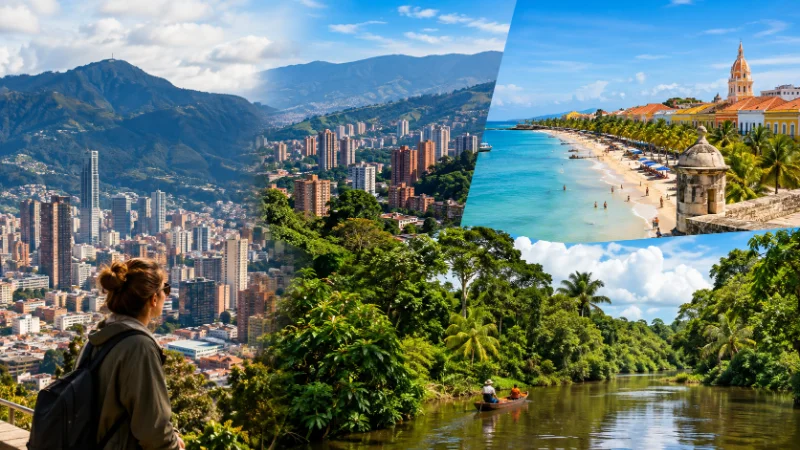
A common route for a two-week trip pairs Bogota or Medellin with Cartagena and one coastal or mountain add-on, such as Tayrona or the coffee region, rather than trying to include every region on this list.