
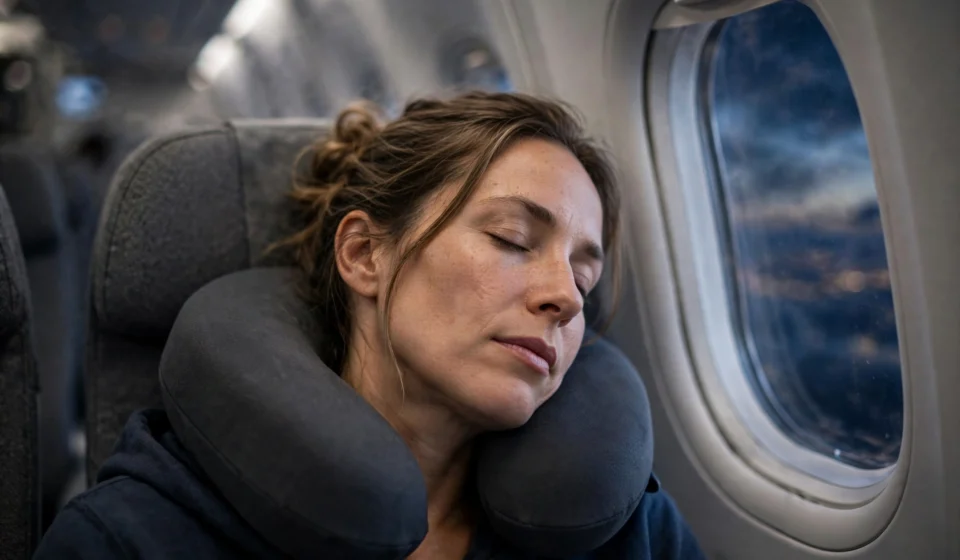
The best travel pillow for long flights is the one that matches how you sleep, not the one with the longest feature list. If your head drops forward when you doze off, you need chin support or a seat-anchored design. If you lean toward the window, you need lateral support on one side. If your bag is already full, an inflatable or flat-folding wrap beats the plushest foam you leave at home. This guide does not pretend we flew around the world testing every pillow on the shelf. No honest blog can claim that. Instead it gives you the buying framework behind the designs that consistently earn top marks from reviewers who do test them: the support types, the tradeoffs, and the checklist that matters at hour nine of a long-haul flight.
Why Economy Seats Punish Your Neck
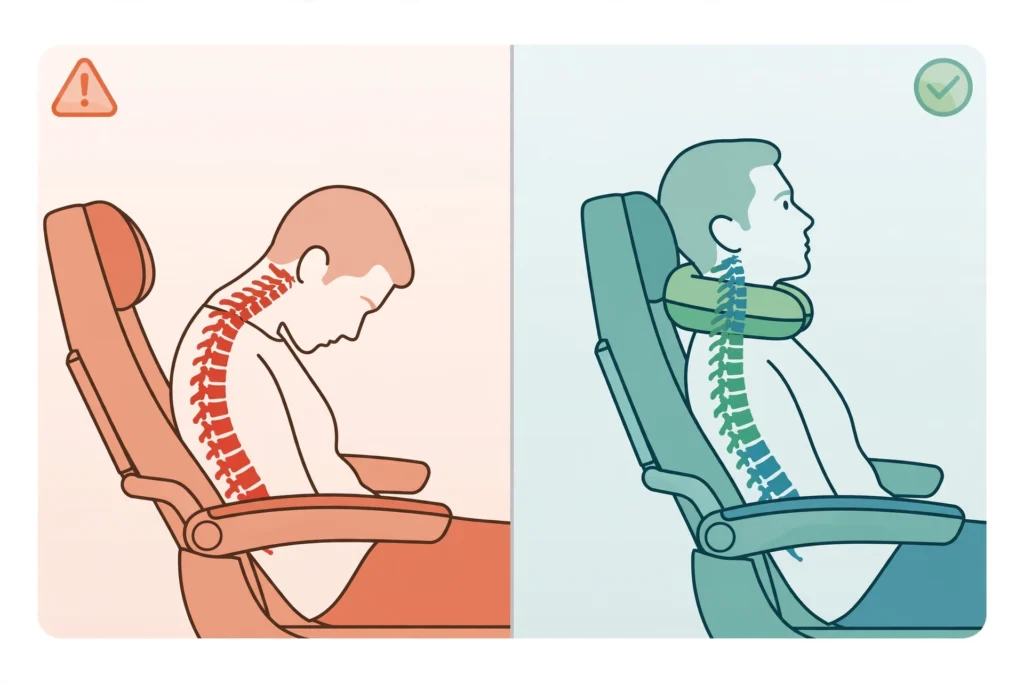
A reclined economy seat holds your body at roughly a 100 to 110 degree angle. That is not flat and not fully upright. Your head weighs around 10 to 12 pounds, and the moment you doze off it drops forward or sideways, hanging your neck muscles under load for hours. On a short hop that is a minor annoyance. On an 8 to 14 hour route it becomes real stiffness by landing.
Economy seating adds a second problem. Whatever pillow you bring has to work inside a tight footprint without spilling into your neighbor’s space. That constraint rules out more designs than most buyers expect.
Sleep posture research backs the basic point. Harvard Health’s guidance on sleep position and neck pain notes that keeping the neck supported in its natural curve, rather than bent forward or sideways, is what prevents morning stiffness. A plane seat is the worst version of that problem: upright, immobile, for half a day. Read their overview in Harvard Health on sleep position and neck pain.
The 7-Point Long-Haul Checklist
Use this checklist to judge any best travel pillow for long flights before you buy it. If a product page cannot answer these seven questions, move on.
Forward-Head Support (Chin Support)
This is the single most important feature for most flyers. A basic U-shaped pillow cushions your sides but does nothing when your chin drops to your chest. That forward nod is the most common complaint on long flights. Look for a raised front section, a wraparound design that catches the chin, or a seat-strap model that anchors your head to the headrest. If you know you nod forward, rank this feature above everything else, including softness.
Lateral Support For Side Leaning
If you lean toward the window, symmetrical support wastes half the pillow. You need support built up on one side, not spread evenly all around. Asymmetric designs, longer wrap pillows, and side-sleeper shapes like the J-Pillow style exist for exactly this. Window-seat sleepers should look for models that let them load weight onto one side without the pillow shifting.
Fit For Your Neck Size
A pillow sized for an average neck leaves gaps on a small neck and strangles a large one. Gaps mean your head moves. Pressure means you take the pillow off after an hour. Check for adjustable closures: toggles, velcro, drawcords, or wrap designs you can tighten. Some manufacturers publish neck-size ranges, though these are rarely standardized, so treat them as rough guidance and prefer adjustability.
Seat Anchoring And Closure
A pillow that slides off mid-nap is useless no matter how soft it is. The closure system is what keeps support where your neck is. Snaps, clips, velcro, and toggle cords all work if they stay fastened. Seat-strap models go further and anchor to the airplane headrest itself, which is the strongest answer to sliding. Note the catch: straps need a headrest with something to grip, and some cabins have flush seatbacks with nothing to loop around.
Packed Size And Weight
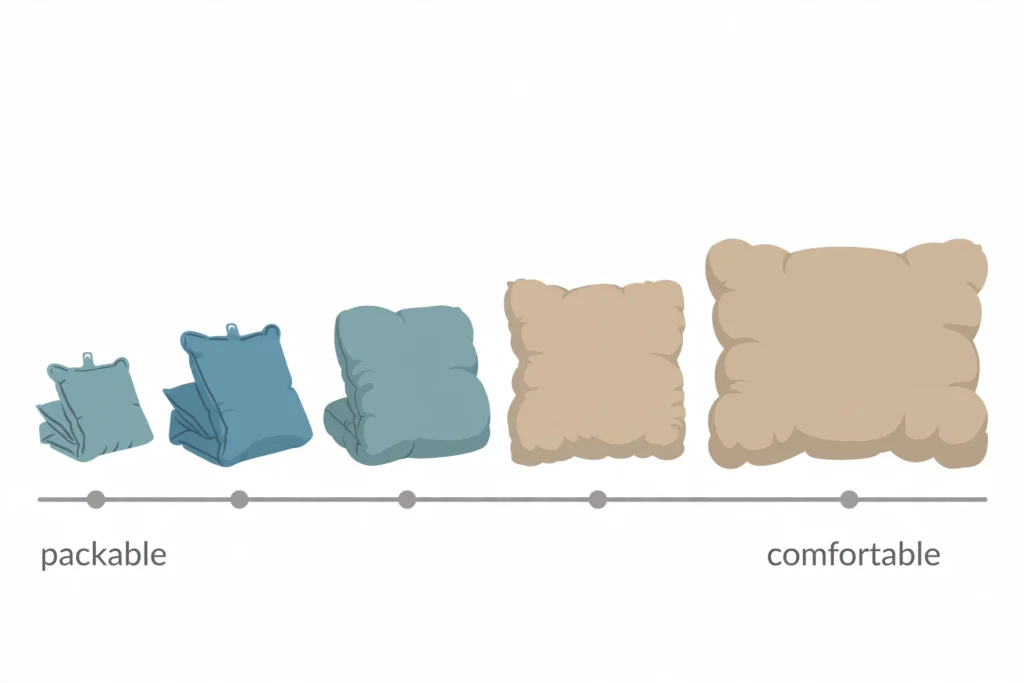
The best pillow is the one you actually bring. Foam pillows sit at the comfort end of the scale but take real bag space. Inflatables deflate to pocket size but feel firmer. Wraparound braces fold flat and sit in the middle. Be honest about your packing style. If you travel carry-on only with a full bag, a bulky foam pillow will get left behind on trip three, and a left-behind pillow helps nobody.
Washable Cover And Heat Control
You will press your face into this thing for hours across multiple flights. A removable, machine-washable cover is not a luxury. It is basic hygiene. Heat matters too. Memory foam retains warmth, and full-wrap designs trap it around your neck. If you sleep hot, prefer breathable covers, open designs, or wraps you can loosen. WebMD’s neck pillow guide notes that materials which wick heat and sweat can help you sleep more deeply, which is exactly the problem on an overnight flight. See WebMD’s guide to neck pillows.
Headphone And Eye Mask Clearance
Over-ear headphone users should check where the pillow meets the ear. Tall-backed pillows press against ear cups. Seat-strap systems can sit right where a headband wants to be. Low-sitting wraps and chin-focused designs usually clear headphones because the contact point sits below the ear. If headphones are non-negotiable for you, this is a top-three criterion, not an afterthought. Almost no product page mentions it, so check buyer reviews for the specific clash.
| Checklist item | What to check on the product page | Red flag |
|---|---|---|
| Forward-head support | Raised front, chin rest, or seat strap | Flat U-shape with no front closure |
| Lateral support | Asymmetric fill or wrap length | Even, thin padding all around |
| Neck-size fit | Adjustable closure, size range | One fixed size, no adjustment |
| Anchoring | Strap, clip, velcro that locks | Loose wrap with no closure |
| Packed size | Packed dimensions, compression bag | No packed size listed |
| Washability and heat | Removable machine-washable cover | Hand wash only, full foam wrap |
| Headphone clearance | Low profile or below-ear contact | Tall back plus strap system |
Travel Pillow Types Compared
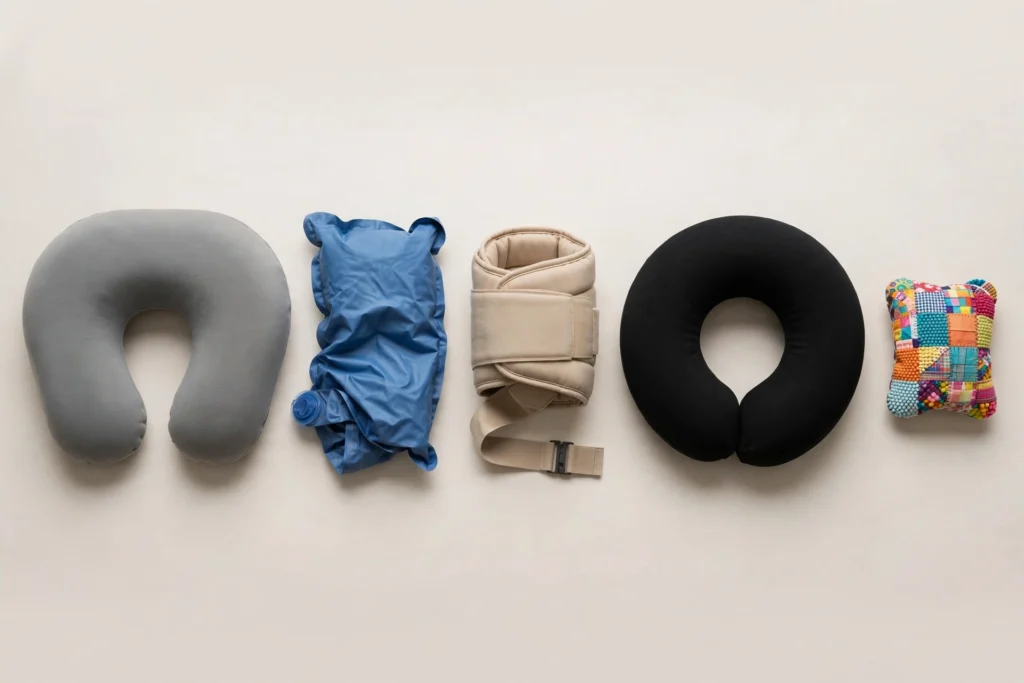
Every best travel pillow for long flights belongs to one of five design families. Here is what each one does well and where it falls short.
U-Shaped Memory Foam Pillows
This is the shape most people picture. Dense foam contours to your neck and holds that shape for hours instead of flattening. Support is high. Packability is medium: many compress to about half size in a bag, but they still claim real carry-on space. Best for comfort-first flyers on flights over eight hours. Watch for heat buildup on long sectors and bulk in a packed bag. CertiPUR-US certified foam is a plus for low chemical odor, but treat certification claims as marketing until verified on the manufacturer’s page.
Inflatable Pillows
Inflatables solve the packing problem completely. Deflated, they fit in a jacket pocket or the side of a personal item. You adjust firmness by adding or releasing air, which is a genuine advantage: a few breaths out turns a firm bolster into something that cradles. Support is medium. Air responds to movement instead of holding a fixed contour, so they feel less plush than foam. Best for one-bag travelers and light packers. Watch for overinflation: fill to soft-firm, not maximum, since cabin pressure changes on climb can stress a fully pumped bladder.
Wraparound Brace Pillows
A newer category skips the U-shape. A flexible internal brace wrapped in fabric holds the head at an angle instead of cushioning from underneath. You secure it around the neck and lean into the brace. Packability is good: they fold flat and ride easily in a daypack. Best for forward-nodders and aisle or middle seats where there is no wall to lean on. The catch is fit: expect a flight or two of trial and error to find your position, and the one-sided support feels strange at first.
360-Degree Compact Foam Pillows
These wrap all the way around with foam, supporting chin, sides, and back of the neck in one piece. They sit between bulky U-shapes and thin wraps: more support than a brace, less bulk than a full U-pillow. Best for travelers who want maximum coverage without the biggest foam pillow. Watch the closure system: magnetic or velcro closures must hold through a whole flight, and tall backs can feel constricting if you prefer leaning back against the headrest.
Microbead Pillows
The budget category. Tiny beads mold to your neck and the pillow squishes into odd spaces, which is handy for unusual seat shapes. Some convert from U-shape to rectangle for window-seat or lumbar use. Support fades over a full long-haul flight as beads shift. Best for short hops, as a backup, or for travelers who want to spend very little. Do not expect a microbead pillow to carry you through a 12-hour overnight sector.
| Type | Support | Packability | Best for | Watch out |
|---|---|---|---|---|
| U-shaped memory foam | High | Medium | Comfort-first, 8+ hour flights | Heat, bulk |
| Inflatable | Medium | Excellent | One-bag, light packers | Firmness, overinflation |
| Wraparound brace | High (angled) | Good | Forward nodders, aisle/middle | Fit learning curve |
| 360-degree compact foam | High | Medium | Max coverage, less bulk | Closure strength, tall back |
| Microbead | Low-Medium | Medium | Budget, short hops | Beads shift on long flights |
Choose By Your Sleep Position
Match the sleeper to the design. This is the decision that matters most.
| If you sleep like this | Pick this type | Why |
|---|---|---|
| Window leaner (side sleeper) | Lateral or asymmetric wrap, side-sleeper design | Support where your weight actually lands |
| Upright nodder (chin drops) | Chin-support wrap, raised-front U, or seat-strap model | Only these resist forward head drop |
| Position shifter | Long wraparound foam | Surface to lean into whichever way you tip |
| Back leaner (against headrest) | Slim-back contoured U | Thick rear bolsters pitch the neck forward |
| Aisle or middle seat | Brace or wrap with strong closure | No wall to lean on; the pillow must stay put alone |
Your seat choice changes the answer. A window seat gives you a wall, so a lateral-support pillow shines. An aisle or middle seat gives you nothing, so anchoring and closure matter more than softness. Pick your seat strategy first, then the pillow.
Best Travel Pillow For Long Flights By Traveler Type
The design examples below are the models that reviewers and frequent flyers mention most often, grouped by the problem each design solves. Specs change, so check the manufacturer’s current page before buying.
Frequent Long-Haul Flyers
If you fly 10-plus-hour routes regularly, comfort compounds. A premium memory foam pillow or a 360-degree compact wrap pays for itself across repeated trips. Prioritize a removable washable cover, because you will use this pillow across many flights without laundry access. Dense foam that holds contour past hour six matters more than any bundled accessory.
One-Bag And Light Packers
Your constraint is volume, not money. An inflatable pillow or a flat-folding wraparound brace is the right call. Deflate fully at landing and tuck it into a personal item. If you go foam, strap it to the outside of your carry-on luggage for international travel so it never competes for interior space.
Budget Travelers
A basic inflatable or microbead pillow covers the core need: something between your head and the seat. Expect to replace budget models sooner, since cheap foam flattens and beads shift. For a first long-haul trip, a low-cost inflatable is a reasonable experiment before you invest in foam.
Hot Sleepers
Memory foam retains heat, and full wraps trap it. If you run warm, look for breathable or moisture-wicking covers, open designs you can loosen, and lower-profile wraps that leave skin exposed to cabin air. Materials that wick heat and sweat help you sleep more deeply, per WebMD’s guide to neck pillows. Avoid the fully enclosed 360 wraps unless the cover is genuinely breathable.
Tall Travelers And Larger Necks
Standard pillows are built for average necks. If yours is larger, check for adjustable closures with real range, higher side walls, and wrap designs you can loosen. A fixed-size U-pillow that cannot close will ride up and do nothing. Adjustability beats brand here.
Kids And Petite Travelers
Adult U-shaped pillows swallow small necks and push the head forward. Look for junior or compact sizes with the same design logic: chin support for nodders, lateral support for leaners. Whatever you buy, have the child try it at home first, since fit matters more at small sizes.
Packability Vs Comfort: The Real Tradeoff
Every travel pillow sits somewhere on one line. Foam sits at the comfort end: plush, contouring, supportive for hours, but bulky. Inflatables sit at the packability end: pocket-sized when deflated, firmer and less cradling when in use. Wraparound braces and compact foam sit in the middle. The decision rule for picking the best travel pillow for long flights is simple. For flights over eight hours, favor comfort: you will feel the difference at hour ten. For short hops and trips where bag space is the binding constraint, favor packability: a pillow you bring beats a better one left at home. Most frequent flyers end up owning two: foam for long-haul, inflatable for everything else.
6 Mistakes That Waste Money On Travel Pillows
Even the best travel pillow for long flights fails if you buy it for the wrong reasons. These are the six that cost buyers the most.
Buying on looks. A sleek pillow can offer zero neck support. Check fill material and support design first, color last.
Ignoring neck size. The most common fit failure. If the closure cannot adjust to your neck, the pillow migrates and your head follows.
Skipping the strap or closure. Without one, the pillow slides off the moment you doze off. That defeats the entire purpose.
Forgetting washability. You press your face into this for hours. A non-removable cover on a long-haul pillow is a hygiene problem by trip three.
Overinflating an air pillow. Maximum firmness feels supportive for twenty minutes, then punishing. Fill to soft-firm and let your head settle in.
Mismatching the pillow to your travel style. The plushest foam is the wrong buy for a one-bag traveler, and the tiniest inflatable is the wrong buy for a monthly long-haul flyer. Match the tool to the trip.
Packing, Wearing, And Care Tips
Once you own the best travel pillow for long flights, using it right matters as much as buying it right. Unpack or inflate your pillow after boarding, not during takeoff. Foam needs time to decompress from a compression bag, and fumbling with gear in a crowded aisle annoys everyone. Strap or clip the pillow to the outside of your bag when the design allows it. Digging a bulky pillow out of a packed carry-on at the gate wastes time. When you pack clothes around it, fold soft items like scarves around the pillow rather than crushing it under heavy layers; the same logic in our guide to how to pack a suit in a suitcase applies here: structure goes in last, soft goods fill the gaps. For security, travel pillows are not a problem. They pass through screening without issue, and most airlines treat a worn neck pillow as a personal comfort item rather than extra baggage. Rules vary by carrier, so check current airline and TSA carry-on rules if you fly budget airlines with strict allowances. Wash removable covers between long trips. A pillow pressed against your neck for hours across multiple flights collects oil and sweat like any pillowcase. Several foam models let you detach the support structure from the fabric so only the fabric goes through the wash. Pair the pillow with a scarf or compact blanket for extra side support when the pillow alone is not enough. And build the rest of your comfort kit around the same trip: reusable travel bottles for water through the flight and an insulated ceramic travel mug for coffee after landing beat any pillow at making a long-haul morning bearable.
What A Pillow Cannot Fix
Honesty matters here. A pillow reduces neck strain and limits how far your head moves. It cannot fix turbulence, a 29-inch seat pitch, cabin noise, or dry recirculated air. No pillow guarantees sleep, because sleep depends on factors no neck support controls. The research is modest on this point too. Reviews of neck-pillow studies have found limited evidence that they relieve neck pain, which means you should buy for comfort and support during the flight, not for a medical outcome. Pair the pillow with earplugs or noise-canceling headphones, an eye mask, water, and a walk down the aisle every few hours. The pillow is one piece of the kit, not the kit.
Bottom Line
The best travel pillow for long flights is the one that fits your neck, matches your sleep position, and actually makes it into your bag. Run the 7-point checklist before you buy. Side sleepers need lateral support. Forward nodders need chin support or seat anchoring. Light packers need packability. Get those three decisions right and the brand barely matters.
Updated October 2026.