
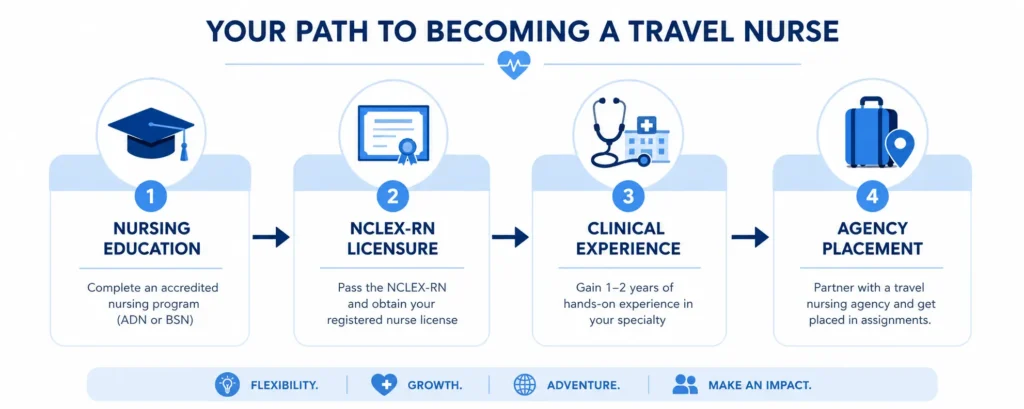
To become a travel nurse, you need a nursing degree, an RN license, and at least one to two years of clinical experience before agencies will hire you. Most nurses complete this path in three to four years total, then join a staffing agency to find short-term contracts across the country.
What Does a Travel Nurse Actually Do
A travel nurse is a registered nurse who works temporary contracts through a staffing agency instead of a permanent hospital job. Assignments usually run 13 weeks, though some stretch from a few weeks to over a year. You might work in a busy ICU in Texas one quarter and a rural ER in Montana the next. Long shift rotations and frequent moves make learning to stay fit while traveling essential.
Hospitals hire travel nurses to cover seasonal spikes, staff shortages, or maternity leave gaps. In return, you get higher pay, housing stipends, and the chance to work in different specialties and cities.
Step 1 – Complete a Nursing Education Program
Every travel nurse starts as a registered nurse, and every RN needs formal training first. You have two main options.
An Associate Degree in Nursing (ADN) usually takes two years and gets you into the field faster. A Bachelor of Science in Nursing (BSN) takes four years but opens more doors, since many hospitals and agencies now prefer BSN-prepared nurses for competitive assignments. If you already hold an ADN, an RN-to-BSN bridge program can fill the gap later without starting over.
ADN or BSN – Which One Should You Pick
If you want to start working sooner and don’t mind upgrading your degree down the line, an ADN is a reasonable start. If you’re aiming for ICU, ER, or other high-demand specialty units, a BSN will make your applications stronger from day one.
Step 2 – Pass the NCLEX-RN and Get Licensed
After finishing your nursing program, you’ll sit for the NCLEX-RN, the standardized exam every RN candidate in the US must pass. Once you clear it, you apply for licensure in your home state’s board of nursing.
This step isn’t optional or skippable. Every state requires an active RN license before you can practice, and agencies will verify it before placing you on any assignment.
Why the Nurse Licensure Compact Matters for Travel Nurses
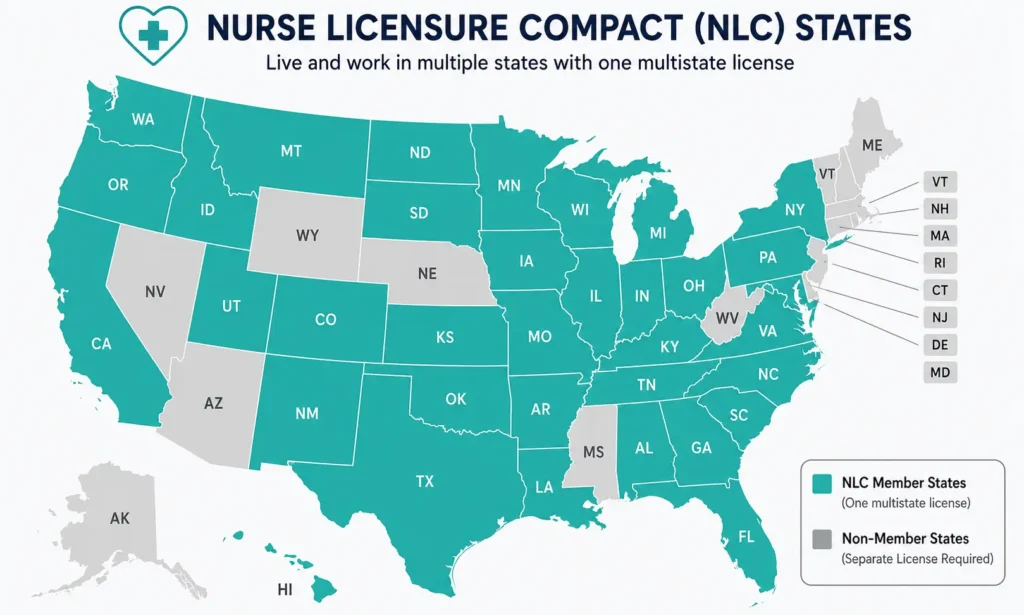
The Nurse Licensure Compact (NLC) lets RNs practice in other participating states without applying for a separate license each time. As of early 2026, most US states participate in the NLC, though notable holdouts like California still require their own state license. If your destination state isn’t in the compact, budget extra time and paperwork for that separate application.
Step 3 – Gain Hands-On Clinical Experience
This is the step most new nursing grads underestimate. Travel nursing agencies almost never hire straight out of school. Most require one to two years of hospital-based experience in your specialty before they’ll even review your application.
Use this time to build real skills, not just tenure. Work in a busy unit, ask questions, and get comfortable making fast decisions under pressure, because that’s exactly what a new travel assignment will demand from week one.
Which Specialties Are in the Highest Demand
ICU, emergency room, labor and delivery, and med-surg nurses tend to get the most assignment offers and the best pay rates, since hospitals feel staffing shortages hardest in these units. If you’re still choosing a specialty, picking one of these can shorten your job search later.
Step 4 – Get the Right Certifications
Beyond your RN license, agencies expect you to hold Basic Life Support (BLS) and Advanced Cardiovascular Life Support (ACLS) certifications, and some specialty units will ask for more, like Pediatric Advanced Life Support (PALS) for a children’s unit or a Trauma Nursing Core Course (TNCC) for the ER.
Keep these current before you start applying. A lapsed certification can delay your start date by weeks while a hospital’s credentialing office waits on paperwork.
Step 5 – Choose a Travel Nursing Agency
Once you meet the experience and certification bar, it’s time to pick an agency. This part matters more than most new travel nurses expect, since your agency negotiates your pay, handles your contracts, and often arranges your housing.
Talk to travel nurses in your current hospital if you can. Ask which agencies they’ve used, how support was during a rough assignment, and whether pay matched what was promised upfront. Compare a few agencies before signing, the same way you’d compare job offers.
What Agencies Look for in an Application
Beyond your license and certifications, agencies want a clean resume that highlights your specialty experience, any float-pool or cross-training background, and references who can vouch for how you handle a fast-changing environment. A recruiter will usually walk you through what’s missing before you submit anything.
Step 6 – Apply for Your First Assignment
With an agency on board, you’ll browse open contracts filtered by specialty, location, and length. When something fits, your recruiter submits your profile, and if the facility is interested, expect a short remote interview, often just 15 to 20 minutes.
If you get the offer, your recruiter will help sort logistics: housing, travel dates, and orientation schedule. Most first-time travel nurses take a shorter 8-13 week contract to test the waters before committing to a longer one.
How Much Do Travel Nurses Earn
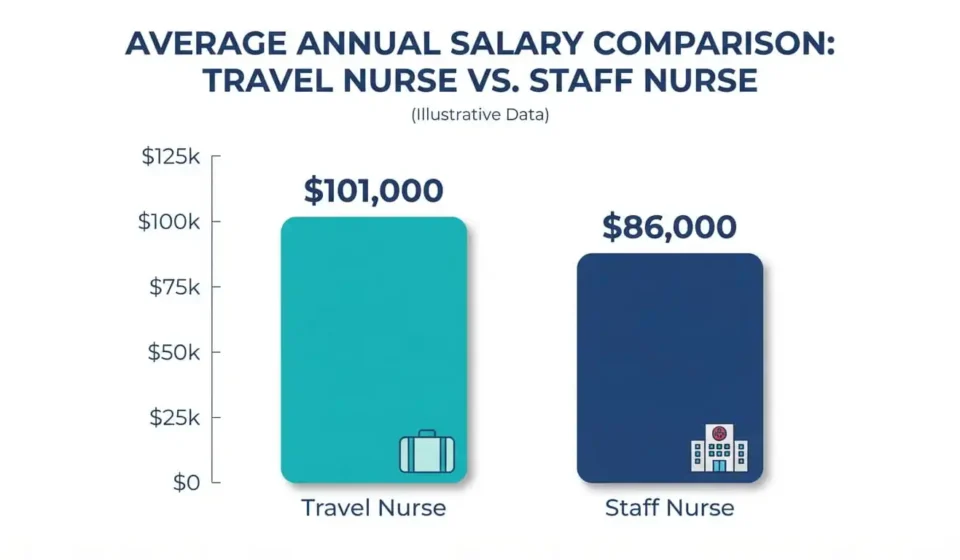
Pay varies a lot by specialty, location, and how urgently a facility needs staff. Travel nurses in California, for example, average around $101,000 annually compared to roughly $86,000 for staff nurses in similar roles, according to MedPro Healthcare Staffing. On top of base pay, most contracts include tax-free stipends for housing and meals, which can meaningfully raise your take-home pay if you maintain a legal tax home elsewhere.
Stat Needed: A national (not state-specific) average travel nurse salary figure from a verifiable source like the Bureau of Labor Statistics or a major staffing industry report would strengthen this section.

Is Travel Nursing Right for You
Travel nursing suits people who adapt fast, don’t mind frequent moves, and can walk into an unfamiliar unit and get productive within days. The upside is real: higher pay, new cities, and a faster route to broad clinical experience.
The tradeoffs are real too. You’ll deal with housing logistics every few months, less job stability than a permanent role, and the occasional bout of homesickness. Many nurses treat travel nursing as a multi-year chapter rather than a permanent career, then settle into a staff position once they’ve found a city or specialty they love.
FAQ‘S
How Long Does It Take to Become a Travel Nurse?
Most people need three to four years total: two years for an ADN or four for a BSN, plus one to two years of clinical experience before agencies will place you.
Can You Become a Travel Nurse Right Out of Nursing School?
No. Nearly every staffing agency requires at least one to two years of hospital experience in your specialty before considering your application.
Do You Need a BSN to Be a Travel Nurse?
Not always. An ADN qualifies you for many assignments, but a BSN makes you more competitive, especially for specialty units like ICU or ER.
How Much Do Travel Nurses Make?
Pay depends heavily on specialty and location, but travel nurses typically out-earn staff nurses in the same role once stipends and bonuses are included.
Do Travel Nurses Need a License in Every State They Work In?
Not if the state participates in the Nurse Licensure Compact. If it doesn’t, like California, you’ll need to apply for a separate state license.
How Long Are Travel Nursing Contracts?
Most run around 13 weeks, though contracts can range from a few weeks to over a year depending on the facility’s needs.
Planning your itinerary connects smoothly with travel agent rates and hotel discounts.