

The best things to do in Oxford are touring a historic college, visiting the free Ashmolean Museum, climbing a tower for views of the spires, punting on the River Cherwell, and finishing the day in a centuries-old pub. Most of these sit within a fifteen-minute walk of Carfax Tower, so one day can cover a lot.
This guide covers the sights worth queueing for, the free options, and the practical traps that catch first-time visitors, such as college closures. It ends with a one-day route you can follow as written.
How to Plan Your Visit
Oxford is compact, and walking is the best way to get around the centre. Trains from London Paddington take about an hour, and coach services also run from the capital.
Late spring and early autumn give the best mix of weather and thinner crowds. July and August are the busiest months, and some colleges restrict visitors during the exam term, which runs from roughly late April into June.
One day is enough for the highlights. Two days let you add a longer museum visit, a river trip, and a college most tourists miss.
Historic Colleges Worth Going Inside
Oxford University has dozens of colleges, and only some admit visitors. Hours and ticket rules change by college and by season, so check each college’s own website before you go.
1. Christ Church
Christ Church is the most visited college in the city. Its grand staircase was filmed for the Harry Potter movies, and the Great Hall inspired the Hogwarts dining hall. The college cathedral is often described as the smallest in England.
The college also has a link to Alice in Wonderland. Lewis Carroll, whose real name was Charles Dodgson, taught mathematics here, and Alice Liddell was the daughter of the college dean. Book timed tickets online during busy months because entry can be limited at short notice.
2. Magdalen College and Addison’s Walk
Magdalen (pronounced “Maudlin”) has the most attractive grounds of the central colleges. It has a deer park, a riverside loop called Addison’s Walk, and a bell tower that has overlooked Magdalen Bridge since the early 1500s.
C.S. Lewis was a fellow here for nearly thirty years, so the walk suits anyone who has read Narnia.
3. Merton and New College
Merton’s Mob Quad dates to the 1300s and houses one of the oldest college libraries in the country. The cobbled street outside is often close to empty.
The cloisters at New College also appear in the Harry Potter films, and they are peaceful even in high season.
The Bodleian Library and Radcliffe Square
Radcliffe Square is the postcard centre of Oxford. The domed Radcliffe Camera, a Bodleian reading room, stands in the middle, with St Mary’s church on one side and All Souls College on another. You can admire the exterior freely, but as a rule only registered readers can go inside.
1. Inside the Bodleian
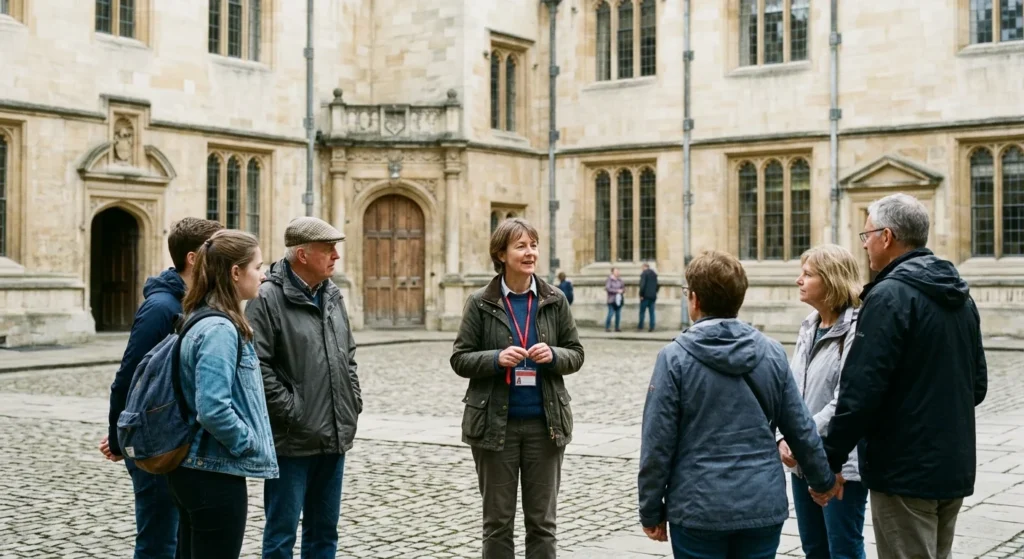
Guided tours of the Bodleian visit the Divinity School, a fifteenth-century hall with an elaborate vaulted ceiling. Some tours also include Duke Humfrey’s Library, the oldest reading room in the Bodleian. Both were used in the Harry Potter films, so book ahead in summer.
2. Views From Above
The Sheldonian Theatre, designed by Christopher Wren in the 1660s, has a cupola with a wide view over the roofs and spires. The tower of the University Church of St Mary the Virgin looks straight down on the Radcliffe Camera, though the spiral stair is narrow. Carfax Tower, at the crossing of the four main streets, is the simplest climb.
Free Museums You Should Not Skip
Several of Oxford’s best museums charge nothing for general entry. That changes what a budget visit looks like.
The Ashmolean says it is the oldest public museum in Britain, opened in 1683. The collection runs from Egyptian mummies to Pre-Raphaelite paintings, and the rooftop restaurant has a good view of the city.
The Oxford University Museum of Natural History has a Gothic iron-and-glass hall filled with dinosaur skeletons, plus remains of the Oxford Dodo. A doorway leads to the Pitt Rivers Museum, a dim, crowded space of world archaeology and anthropology in glass cases. Go in with one question in mind, or you will drift for hours.
The History of Science Museum on Broad Street holds astrolabes and a blackboard from a 1931 Albert Einstein lecture. It takes under an hour and rarely feels crowded.
Punting, Gardens and Riverside Walks
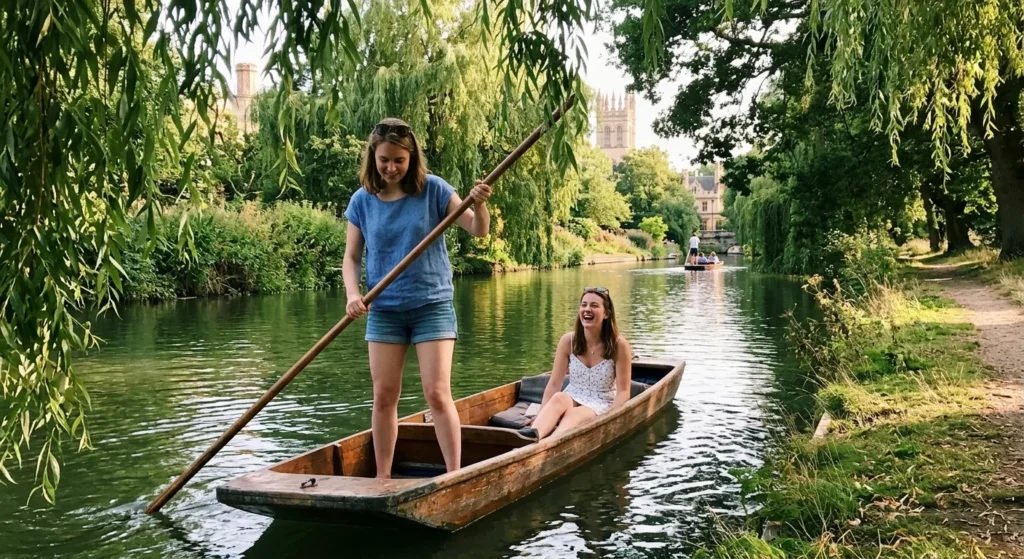
Punting is the classic summer activity. You can hire a punt from Magdalen Bridge Boathouse, or from the Cherwell Boathouse, which tends to be quieter. The pole is heavier than it looks, so expect a wobbly first ten minutes, or pay for a chauffeured punt.
Go early or on a weekday if you can, because the river gets crowded on sunny afternoons and boats queue at the bridges. Bring a waterproof layer, since a punt has little cover. Most hire companies ask for a deposit and a few basic safety rules before you set off.
The University of Oxford Botanic Garden says it was founded in 1621, which makes it the oldest botanic garden in Britain. It sits beside Magdalen Bridge, and its glasshouses are a good wet-weather option.
For a free walk, follow the flat path around Christ Church Meadow, with views of the college and the river. Or continue to Port Meadow, ancient common land mentioned in the Domesday Book, where cattle and horses still graze. The Perch at Binsey and the Trout Inn near Godstow both make good stops on the route.
Where to Eat and Drink
The Covered Market, open since 1774, is a good lunch stop, with butchers, coffee counters and Ben’s Cookies. It works well on a rainy day.
The Turf Tavern sits down a narrow passage off Holywell Street and is one of the oldest pubs in the city, with a courtyard for summer evenings. The Lamb & Flag on St Giles is calmer, and The Bear Inn near Christ Church is tiny, with walls of displayed ties.

For dinner away from the tourist centre, Cowley Road has a long strip of independent restaurants serving food from many countries.
Free Things to Do in Oxford
A good day in Oxford can cost very little. The Ashmolean, the Natural History Museum, the Pitt Rivers Museum and the History of Science Museum are all free for general entry.
Outdoors, Radcliffe Square, Christ Church Meadow, University Parks and Port Meadow cost nothing. The Bridge of Sighs, the covered bridge over New College Lane that links two halves of Hertford College, is another free stop, and it is one of the most photographed corners of the city. Paid extras, such as a college ticket or a punt, then become a treat rather than a necessity.
Bookshops and Broad Street
Blackwell’s on Broad Street is the best-known bookshop in the city, and its Norrington Room is a large underground hall of shelves. Allow more time than you plan, because it is easy to lose an hour there.
Outside, the stone heads ringing the Sheldonian Theatre look down on the street. A cross of stones in the road nearby marks the spot where the Protestant martyrs Latimer, Ridley and Cranmer were burned in the 1550s.
Literary and Film Trails
The Inklings, a writing group that included J.R.R. Tolkien and C.S. Lewis, met in pubs and college rooms in the 1930s and 1940s. Tolkien is buried in Wolvercote Cemetery in north Oxford, and fans often visit his grave.
Philip Pullman set His Dark Materials in a version of Oxford, and Exeter College is often linked to his fictional Jordan College. Detective fans will find locations from Inspector Morse across the centre. Several operators run themed walking tours if you prefer a guide.
Oxford Castle and Prison
Oxford Castle dates to the 1070s, and the site later became a Victorian prison. Guided tours climb St George’s Tower, part of a Saxon church, and go down into the crypt. It suits families and anyone who likes stories about escapes.
Jericho and the Oxford Canal
Jericho is a former working district north of the centre, now known for independent cafes, Oxford University Press and the Phoenix Picturehouse cinema. It gets far fewer tourists than the colleges.
Follow the canal towpath past moored narrowboats and you reach the Thames near Port Meadow in about half an hour. It is one of the easiest ways to see the city without a crowd.
Things to Do in Oxford With Kids
The dinosaurs at the Natural History Museum and the castle tour are the easiest wins with children. The Story Museum on Pembroke Street is built around children’s books and storytelling.
Outdoors, a punt trip, the Botanic Garden and the cattle that graze on Christ Church Meadow keep younger visitors busy. Port Meadow has space to run, and it is close to a pub with a garden.
Day Trip to Blenheim Palace
Blenheim Palace at Woodstock is about eight miles north of the city. It is a UNESCO World Heritage Site and the birthplace of Winston Churchill. Allow half a day for the house and the parkland shaped by Capability Brown.
Inside, the state rooms and the library hold portraits and tapestries, and the Great Court gives the best first view of the building. The lake and the formal water terraces are worth the walk if the weather holds.
Buses run from Oxford, and taxis are an option for groups. Check timetables in advance because services thin out in the evening.
A One-Day Route Through Oxford
Start with a Bodleian tour on Radcliffe Square, then climb the tower of St Mary’s for the view. Walk to the Ashmolean or the Natural History Museum for late morning, and have lunch at the Covered Market.
In the afternoon, visit Christ Church on a timed ticket and walk around Christ Church Meadow. If the weather is good, finish with a punt, or step into Magdalen for the deer park. End at the Turf Tavern.
On a wet day, swap the meadow and punt for the Botanic Garden glasshouses and the History of Science Museum.
Getting Around and Guided Tours
The centre is small enough to cover on foot, but Oxford is also a cycling city, and bikes can be hired near the station. Buses connect the Park and Ride sites with the middle of town, and they are usually cheaper and less stressful than parking.
If you like context with your sightseeing, book a guided walk. Local guides explain the college system, the history of town and gown tensions, and where the film locations are, which is hard to piece together from signs alone.
Beyond the City
Blenheim is the best-known trip, but the Cotswold villages of Burford and Bibury are also within reach. A car or a small-group tour makes them far easier than public transport.
Practical Notes Before You Go
Colleges close for exams, private events and services, sometimes without much notice. Confirm hours the day before, and have a backup college in mind.
Wear flat, comfortable shoes, because the older streets are cobbled and you will walk several miles. Driving into the centre is restricted, so use a Park and Ride site on the ring road if you arrive by car.
Ticket prices and opening hours change often, so treat any figures you see online as a starting point and check the official pages. Many of the best things to do in Oxford cost nothing, so a paid college and a river trip can round out a low-cost trip.