

US citizens have more places to travel without a passport than most people expect. You can fly to five US island territories with just a photo ID, sail to foreign Caribbean ports on a closed-loop cruise, or cross into Canada or Mexico by land or sea with the right alternative documents. This guide covers every option, the exact paperwork each one needs, and the details that catch travelers off guard. One quick note: everything below applies to US citizens. If you hold a green card or another immigration status, the rules are different and you should check with the State Department before booking.
The Short Answer: Places To Travel Without A Passport Book
Flying to a US territory counts as domestic travel, so no passport book is needed. That covers Puerto Rico, the US Virgin Islands, Guam, and the Northern Mariana Islands with just a valid photo ID, plus American Samoa with one extra document. Beyond the territories, you can take a closed-loop cruise that starts and ends at the same US port, or cross a land or sea border into Canada or Mexico under the Western Hemisphere Travel Initiative. Flying to any foreign country still requires a passport book, with no exceptions.
Match The Trip To The Document You Have
Most guides list destinations and leave you to figure out the paperwork. Flip it around: start with what is already in your wallet.
| What you have | Trips that work | Trips that do not work |
|---|---|---|
| Valid photo ID (REAL ID-compliant license or state ID) | US territories except American Samoa: Puerto Rico, USVI, Guam, Northern Mariana Islands (routed through Honolulu); Hawaii, Alaska, and the rest of the US | American Samoa, closed-loop cruises, Canada/Mexico crossings |
| Photo ID plus a certified birth certificate | Everything above, plus American Samoa (with proof of onward travel) and closed-loop cruises | Flying to any foreign country; driving into Canada or Mexico (a birth certificate alone is not enough for these crossings) |
| US passport card | Everything above, plus land and sea crossings into Canada, Mexico, Bermuda, and parts of the Caribbean | Flying internationally anywhere |
| Full passport book | Every trip on this list, plus the whole world | Nothing |
The pattern is simple. A driver’s license opens the territories. Adding a certified birth certificate opens cruises and American Samoa. The passport card opens land and sea borders. Only the passport book opens international flights.
US Territories You Can Visit With Just An ID
The US has five island territories, and flying to four of them works exactly like flying from Chicago to Denver. You need a valid, government-issued photo ID for the TSA checkpoint. Since REAL ID enforcement began on May 7, 2025, that means a REAL ID-compliant license or state ID (look for the star in the corner), a passport, or another TSA-accepted ID.
Puerto Rico: The Easiest Trip On This List
Puerto Rico is the no-passport trip with the least friction. Direct flights leave from dozens of mainland airports, the US dollar is the currency, and entry works exactly like arriving in any other US city. Most domestic phone plans treat Puerto Rico as domestic coverage. There is plenty to fill a trip beyond the beach. Old San Juan’s colonial forts sit a short walk from the cruise terminal, El Yunque is the only tropical rainforest in the US
National Forest System, and the island’s bioluminescent bays glow on dark nights. For ideas once you land, see our guide to things to do in Puerto Rico, and if the glowing bays sound like your kind of night, our bioluminescent bays guide covers Mosquito Bay in detail. First-timers who want an international feel without immigration lines should start here.

US Virgin Islands: St. Thomas, St. John, And St. Croix
St. Thomas, St. John, and St. Croix sit about 40 miles east of Puerto Rico. St. John is roughly two-thirds national park, so hiking and reef snorkeling sit close to the ferry dock. Flights connect through Miami, Charlotte, and Atlanta, and a photo ID at the gate is all you need for the way in. Here is the detail other guides skip: the trip home is not quite as simple. The US Virgin Islands sit outside the US customs zone, so expect a customs and immigration check when you fly back to the mainland. Have your ID ready and allow extra time at the airport. It is routine, but it surprises first-time visitors. One more warning for boaters. Nearby islands like Tortola and Jost Van Dyke belong to the British Virgin Islands, which is international travel. A day trip across that line changes the documents you need, so check with your charter before you book.
Guam And The Northern Mariana Islands: Watch Your Flight Route
Guam and the Northern Mariana Islands (Saipan, Tinian, and Rota) sit in the western Pacific, more than 6,000 miles from Los Angeles. Both are self-governing US territories, so a domestic ID works for entry. The catch is routing, and this is where people get burned. Flying through Honolulu keeps the trip passport-free. Connecting through Tokyo, Seoul, or any other foreign airport means passing through another country, which requires a passport book. The territory’s entry rule and your flight route are two separate questions. Before you book, trace every leg of the itinerary and confirm no connection leaves US jurisdiction. If it does, bring the passport book or pick a different route. The reward for the planning is real. Guam pairs Tumon Bay beaches with Chamorro culture and World War II history, while Saipan’s Grotto is one of the most striking dive sites in the Pacific. Just note the practical friction: some US carriers treat Guam and the Northern Mariana Islands as international for roaming, so check your plan before you go.
American Samoa: The One That Needs Extra Paperwork
American Samoa is the exception among the five territories. A driver’s license alone is not enough here. US citizens need either a passport or a certified US birth certificate to enter, and you should also carry a valid government-issued photo ID plus proof of onward travel within 30 days. The passport-free route from the mainland runs through Honolulu; connecting through independent Samoa or another foreign country would require a passport book. The trip takes close to 24 hours from the East Coast, making this the most remote option on the list by far. The payoff is the National Park of American Samoa, protecting rainforest, coral reefs, and traditional villages, and one of the least-visited national parks in the entire US system.
Closed-Loop Cruises: The Only Foreign Ports Without A Passport
A closed-loop cruise starts and ends at the same US port, and it is the one way to set foot in a foreign country without a passport. Major lines run these routes from Miami, Fort Lauderdale, and Galveston to Cozumel, Nassau, Grand Turk, and the Bahamas. The ship handles customs as a group, so individual passengers rarely deal with a border agent directly. Our Mexico guide covers Cozumel and other ports if your itinerary heads that way. Some eastern routes stop at Grand Turk in the Turks and Caicos; check current Turks and Caicos travel updates before you sail, since entry guidance can change. Now the warning. A passport is not legally required for the cruise itself, but bring one if you have it. If a medical emergency forces an unplanned flight home from a foreign port, you cannot board an international flight without a passport book. That single scenario is why cruise lines still recommend carrying one.
Documents To Bring Onboard
Cruise lines ask for proof of citizenship, not a passport. That usually means an original or certified copy of your birth certificate plus a government-issued photo ID. A photocopy will not work; the birth certificate has to be certified by the issuing state. Kids need birth certificates too, even infants. Check the exact document list on your booking confirmation before you pack.

Crossing Into Canada Or Mexico By Land Or Sea
Flying to Canada or Mexico still requires a passport book. Driving or taking a ferry is different. Under the Western Hemisphere Travel Initiative, land and sea crossings accept several alternative documents, though the list is narrower than most travelers expect.
Passport Card, Enhanced License, Or Birth Certificate
A US passport card is the simplest option. It costs less than a passport book and works for land and sea entry to Canada, Mexico, Bermuda, and parts of the Caribbean, though not for flights. Five states, Michigan, Minnesota, New York, Vermont, and Washington, issue Enhanced Driver’s Licenses that work the same way. Without either, a certified birth certificate paired with a photo ID is usually enough at the land border. But do not assume every crossing works this way. Border officers can and do ask follow-up questions, and cruise or ferry operators may hold stricter document rules than the border itself.
NEXUS And SENTRI Trusted Traveler Cards
NEXUS speeds up entry to Canada through dedicated lanes; SENTRI does the same at the Mexican border. Both require an application, a fee (around $120 for NEXUS), and an in-person interview, so they suit frequent border crossers more than a one-off trip.
What About Kids Traveling Without Passports?
Families ask this more than anyone, and the rules differ by trip type. For domestic flights to the territories, TSA generally does not require travelers under 18 to show ID, but airlines can have their own age-document rules, so confirm with your carrier. For closed-loop cruises, every child needs proof of citizenship, usually a certified birth certificate, regardless of age. For land crossings into Canada or Mexico, children traveling with a parent generally need only proof of citizenship, not a photo ID. When in doubt, bring the birth certificate. It weighs nothing and settles every question.
REAL ID Vs Passport Card Vs Passport Book
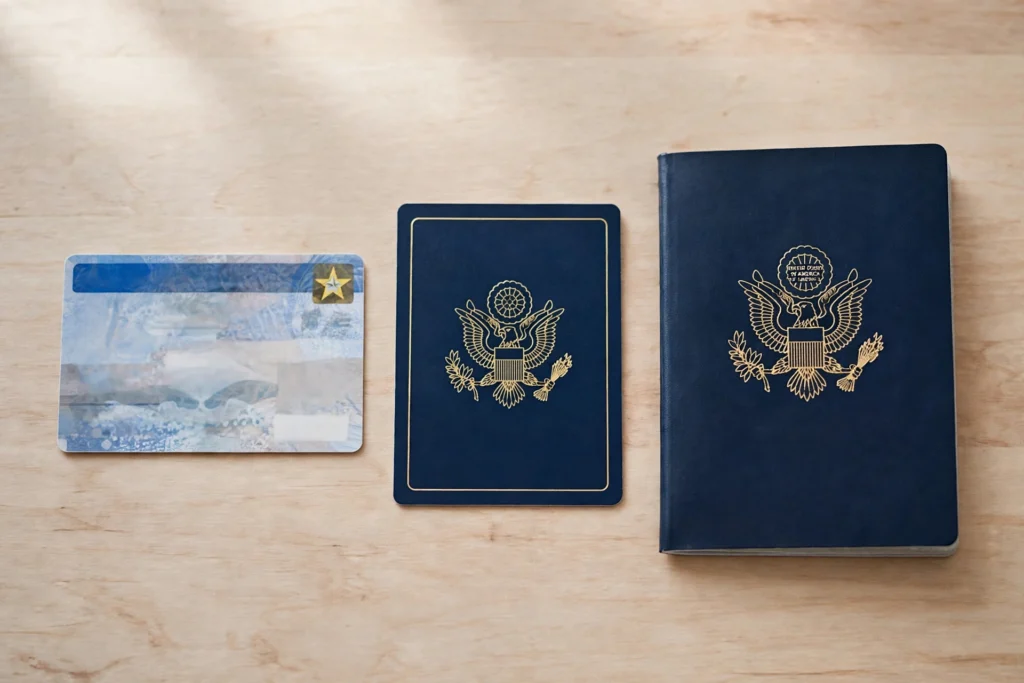
These three documents solve different problems, and mixing them up causes most last-minute airport stress. REAL ID is a federal identification standard for domestic flights and certain federal buildings. It does not grant entry to another country, and it never will. A passport card works at land and sea borders but not for international flights. Only the passport book crosses an international border by air.
| Document | Domestic flights | Land/sea to Canada, Mexico, Caribbean | International flights |
|---|---|---|---|
| REAL ID-compliant license | Yes | No | No |
| US passport card | Yes | Yes | No |
| US passport book | Yes | Yes | Yes |
TSA reported that more than 94 percent of travelers were already presenting a REAL ID-compliant card or an acceptable alternative by December 2025. If your license lacks the star marking, a passport (book or card) still works at the checkpoint.
Domestic Trips That Feel International
Not every getaway needs a border at all. Alaska’s Inside Passage delivers glaciers and whale-watching, with cruise season running roughly May through September for the clearest weather. Hawaii offers a similar shift in pace, from Waikiki’s surf breaks to the volcanic ground of Hawaii Volcanoes National Park. Closer to the mainland, Key West brings Caribbean color without leaving Florida. Our Florida guide covers Key West and the rest of the state if you want to stay domestic but far from ordinary.
Why You Should Still Bring A Passport If You Have One
Bring a passport anyway if you can. It is the one document that works everywhere on this list, and if a cruise ship diverts or a flight reroutes through a foreign airport, it becomes the fastest way home. Roughly 170 million US passports were in circulation as of 2024, according to State Department figures, so there is a good chance yours is sitting in a drawer right now. If you cannot find it, see what to do if you lose your passport before your trip gets close.
The Bottom Line
Places to travel without a passport come down to matching the trip to the document you already hold. Puerto Rico and the US Virgin Islands ask only for a photo ID. American Samoa wants a birth certificate too. A closed-loop cruise or a land crossing has its own short list. Check the specific destination’s document list before you book, not after, and passport-free travel stops being a workaround and starts being just another way to plan a vacation.