California has 840 miles of Pacific coastline, and whales travel within sight of most of it every year. Gray whales pass along this entire route on their migration from Alaska to Mexico. Blue whales, humpbacks, and even orcas show up too, depending on where and when you look. The best places for whale watching in California fall into two groups. Deep water hotspots you reach by boat, and coastal bluffs where binoculars get the job done for free. This guide covers both, broken down by region, along with the months each species actually shows up.
The Quick Answer: Where to Go First
If you only have time for one stop, Monterey Bay gives you the widest mix of species. It also has the most consistent sightings of the whole year. Visiting in winter and want a near guarantee of gray whales? San Diego or Dana Point will get you there fastest, since boats leave right from the harbor into the migration corridor. For a completely free option, head to the bluffs at Point Reyes or the Palos Verdes Peninsula. Both let you watch the same migration without ever boarding a boat.
Monterey Bay: The Most Consistent Sightings in the State
Monterey Bay is the closest thing California has to a whale watching capital, and the reason comes down to geology. A submarine canyon runs within a mile of the shoreline and drops more than two miles deep. The upwelling it creates pulls cold, nutrient rich water toward the surface. That water supports the krill and anchovies whales come here to eat. Sightings hold up across all twelve months rather than clustering around one migration window. Humpback whales gather here in the largest numbers from spring through fall, sometimes by the hundreds when anchovy schools are thick. Gray whales pass by from December through May. Traffic peaks in January, then again in March as they head north with calves. Orcas are the least predictable but show up most often in April and May. The same canyon that draws whales also churns up rougher seas. Anyone prone to motion sickness should consider the shoreline trails around Point Lobos instead.
San Diego: Gray Whales, Blue Whales, and a Growing Orca Pod
San Diego holds the historical claim to whale watching in California. Organized boat tours started here in the 1950s. Cabrillo National Monument was set aside as a public spot to view gray whales. Gray whales pass close to shore from December through April, heading toward the calving lagoons of Baja California. Boats leave daily from the downtown harbor and Mission Bay to intercept them. Blue whales, the largest animals on the planet, feed in these waters from May through September. The more recent development is a resident pod of orcas that has returned to the coast with growing regularity since 2017. Sightings peak from December through April and again in September and October. For shore viewing, Point Loma and the cliffs above La Jolla Cove both sit within sight of the migration corridor. No boat ticket required.
Dana Point and Orange County: The Self-Proclaimed Capital
Dana Point and the rest of Orange County brand themselves as the whale and dolphin watching capital of the world. The claim holds up better than most tourism slogans. The harbor was the first location in the world to earn formal Whale Heritage Site status. That designation is tied to responsible viewing practices, not marketing. Boats here reach open water quickly. The combination of gray whales in winter and resident dolphin pods year round means trips rarely come back empty. Blue and humpback whales also pass through in late summer. They feed in the same nutrient rich water that draws marine life to Monterey and San Diego.
Santa Barbara Channel and the Channel Islands: The Most Species in One Trip
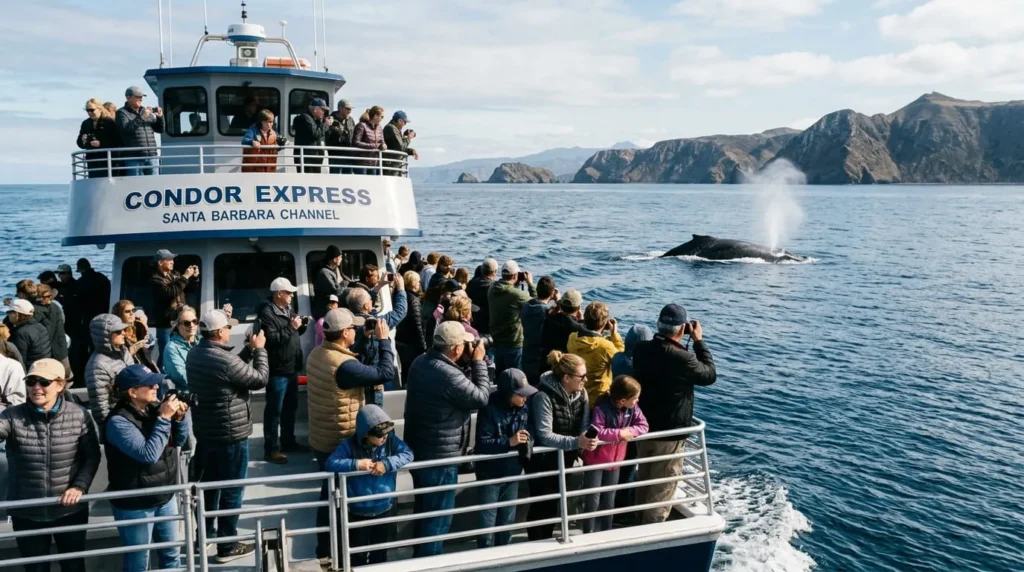
The Santa Barbara Channel and the nearby Channel Islands National Park hold one of the densest concentrations of marine mammals on the West Coast. Roughly a third of all cetacean species found worldwide have been recorded here. That list includes gray, blue, humpback, minke, sperm, and pilot whales, plus several dolphin species. Gray whales move through from mid-December to mid-March. Blue and humpback whales feed here through the summer months. Boats depart from Santa Barbara, Ventura, and the Channel Islands Harbor, and Island Packers runs trips directly into the national park. The channel’s protected status means sightings here often include a wider variety of species than at other departure points.
Los Angeles: Palos Verdes and San Pedro for Easy Access
Los Angeles is easy to overlook for whale watching, but it shouldn’t be. The Palos Verdes Peninsula and San Pedro sit on top of another deep underwater canyon that pulls whales close to shore. Blue, fin, and humpback whales feed here through the summer. Gray whales pass by from December through mid-May, heading south and then back north. Boats leave from San Pedro and the harbor beside the Aquarium of the Pacific in Long Beach. For a free option, the Point Vicente Interpretive Center sits on a bluff along the Palos Verdes Peninsula. It ranks among the better land-based lookouts in Southern California for tracking the gray whale migration.
Northern California: Free Whale Watching from Mendocino to Point Reyes
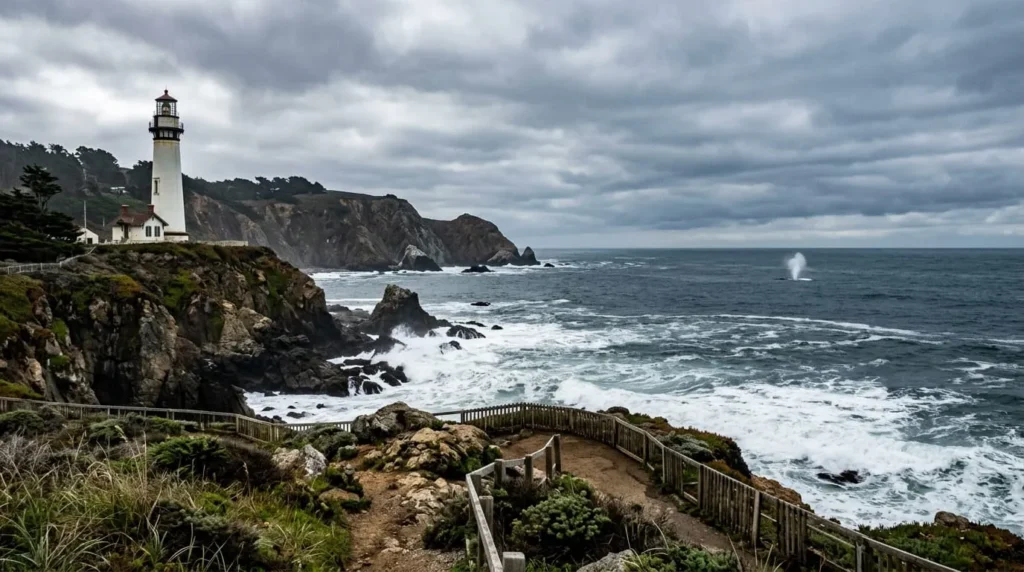
Northern California trades boat tours for cliffside trails. The stretch from Mendocino to Point Reyes offers some of the best free whale watching in the state. Gray whales pass the Mendocino coast from November through February heading south, then return with calves from February through April. Mendocino Headlands State Park and Point Cabrillo Light Station sit on high bluffs above the route. Point Arena Lighthouse, a bit farther north, offers the same clear sightlines. Just north in Fort Bragg, the Noyo Headlands Coastal Trail and MacKerricher State Park add more vantage points. Closer to San Francisco, the headlands at Point Reyes National Seashore extend about ten miles into the Pacific. The Point Reyes Lighthouse and Chimney Rock are widely considered the two best spots on the peninsula. Gray whale traffic peaks here from December through February.
Boat Tour or Shore Viewing: How to Choose
Boats get you closer, and captains follow real-time reports from other vessels on the water. That raises your odds of a sighting on any given trip. They also cost money and carry a real risk of seasickness in spots like Monterey, where the water tends to be choppy. Shore viewing costs nothing beyond the drive. It also lets you linger as long as you want at spots like Point Reyes or Palos Verdes. The tradeoff is distance. Whales viewed from a bluff are farther away and easier to miss without binoculars. A reasonable approach for a longer trip is to pair the two. Book a boat tour for a close encounter, then add a free coastal stop along the drive.
When to Go: California Whale Watching Season by Month
Gray whales dominate the winter calendar. They pass south along the coast from December through February, then return north with calves from February through April. This makes winter the most reliable season for a sighting, from Point Reyes down to San Diego. Blue whales feed off central and southern California from June through October. The Santa Barbara Channel and the waters off Los Angeles are among the most productive spots. Humpback whales show the widest window, appearing off Monterey and San Francisco from March through November. Orcas are the hardest to time precisely. Monterey sees its best odds in April and May. San Diego’s resident pod turns up most from December through April, and again in September and October.
Safety and Whale Watching Etiquette in California
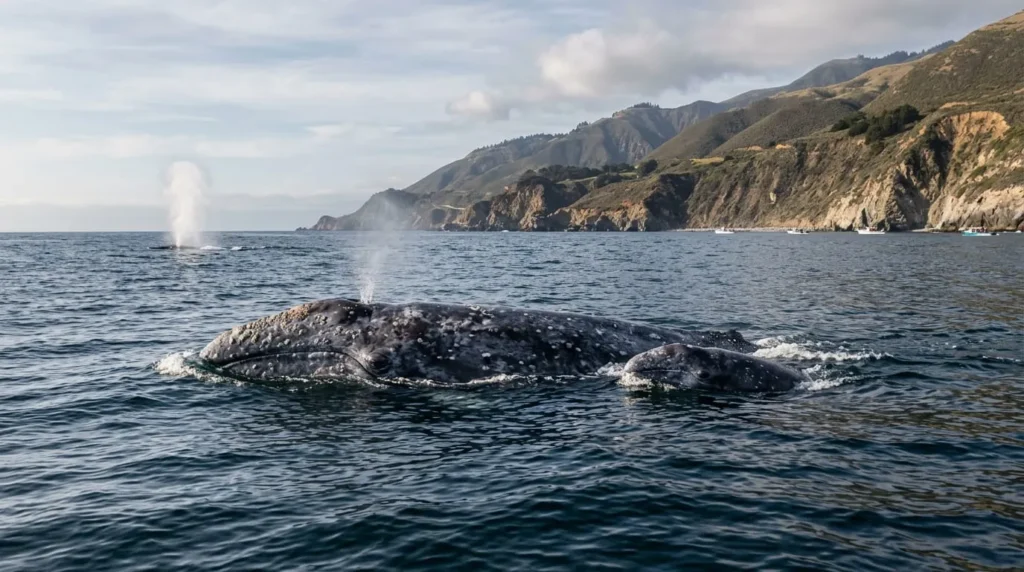
Federal law under the Marine Mammal Protection Act requires boats to stay at least 100 yards from whales. The exception is a whale that chooses to approach on its own. Reputable operators build their routes around this rule. It exists to keep both animals and passengers safe. If you are watching from shore, the rule does not apply directly. The same principle still holds: never approach a whale that comes close to the coastline. Morning trips, before wind creates whitecaps, generally offer calmer water and a clearer view of surfacing whales.