Hand carry luggage size comes down to one number most US travelers should memorize: 22 x 14 x 9 inches, wheels and handles included. That is the standard maximum most US airlines allow for a bag you carry into the cabin and store in the overhead bin. If you want the complete picture across carry-on, checked, and personal item categories, see our full luggage size chart. This guide goes deeper on hand carry specifically: what the term means, how to measure your bag correctly, weight limits at home and abroad, and what actually happens at the gate if your bag is too big.
What “Hand Carry” Actually Means
“Hand carry” is the term many travelers use for the bag you carry onto the plane yourself. In the United States, airlines and airports call it a “carry-on.” The words mean the same thing. Hand carry phrasing is especially common in Asian English, and you will see it on many Asian and Middle Eastern airline sites. So if you searched “hand carry luggage size,” you are asking about cabin baggage: the bag that stays with you during the flight instead of going into the cargo hold. The size rules below use the US standard as the baseline, because that is what most American travelers need. But if you are flying an Asian, Gulf, or European carrier, read the international section carefully. Those airlines often enforce stricter limits.
Hand Carry vs Carry-On vs Personal Item vs Checked
These terms get mixed up. Here is the clean version:
- Hand carry / carry-on: the bag you bring into the cabin. It goes in the overhead bin. One per passenger on most tickets.
- Personal item: a second, smaller bag that must fit under the seat in front of you. Think backpack, purse, or laptop bag. Usually around 18 x 14 x 8 inches. Nearly always free.
- Checked luggage: the bag you hand over at the counter. It travels in the cargo hold. Larger (typically up to 62 linear inches) and often subject to fees.
The key test is simple. If your bag has to go in the overhead bin, it is hand carry and the size rules below apply. If it fits under the seat, it is a personal item with looser rules.
Standard Hand Carry Luggage Size In The US
The standard hand carry luggage size in the US is 22 x 14 x 9 inches (56 x 36 x 23 cm). That matches the FAA guidance of 45 linear inches maximum, which is the total of the bag’s height, width, and depth. Three details matter here: First, the measurements include everything. Wheels, retractable handles, and any protruding pockets all count. This is the number one reason bags fail at the gate. A bag whose main body is 22 inches tall can easily measure 23 or 24 inches once the wheels and handle are included. Second, a few US airlines are slightly more generous. Southwest allows 24 x 16 x 10 inches. Frontier allows 25 x 16 x 10 inches. But these are exceptions, not the rule. Third, airline policies change and fare types matter. Budget fares sometimes include only a personal item, with the carry-on costing extra. Always check your specific airline’s baggage page before you pack.
How Airlines Measure Your Bag
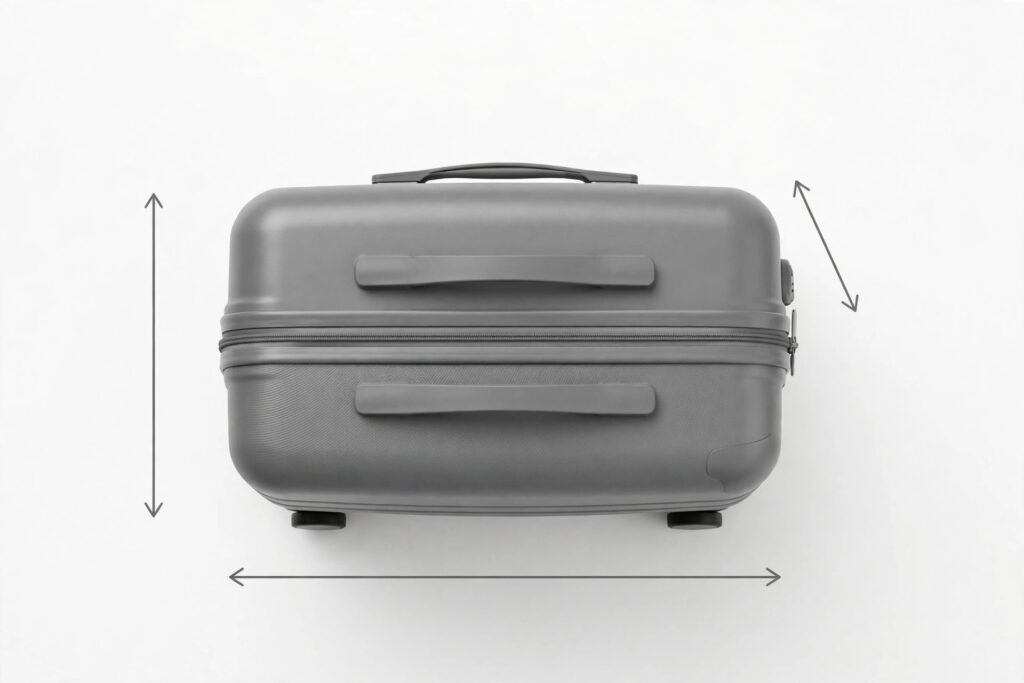
Some airlines, including Delta, American, and Southwest, use linear inches instead of checking each side separately. Linear inches are just the sum of the three sides: length + width + depth. Here is how the math works on a standard bag:
- 22 (height) + 14 (width) + 9 (depth) = 45 linear inches: allowed
- 24 (height) + 14 (width) + 8 (depth) = 46 linear inches: too large
This matters because a bag can look fine on two dimensions and still fail the total. A tall, narrow bag might measure 24 x 12 x 8. Each side looks reasonable. The total is 44, so it passes. But a 25 x 14 x 9 bag totals 48 and would fail even though it is only slightly bigger in one direction.
How To Measure Your Hand Carry Bag At Home
Do not trust the size printed on the tag. Manufacturers sometimes round down, and airline agents measure what is in front of them. Measure your own bag before every trip with a bag you have not flown with yet.
- Empty the bag completely. Close all zippers and collapse any expandable sections to their smallest setting.
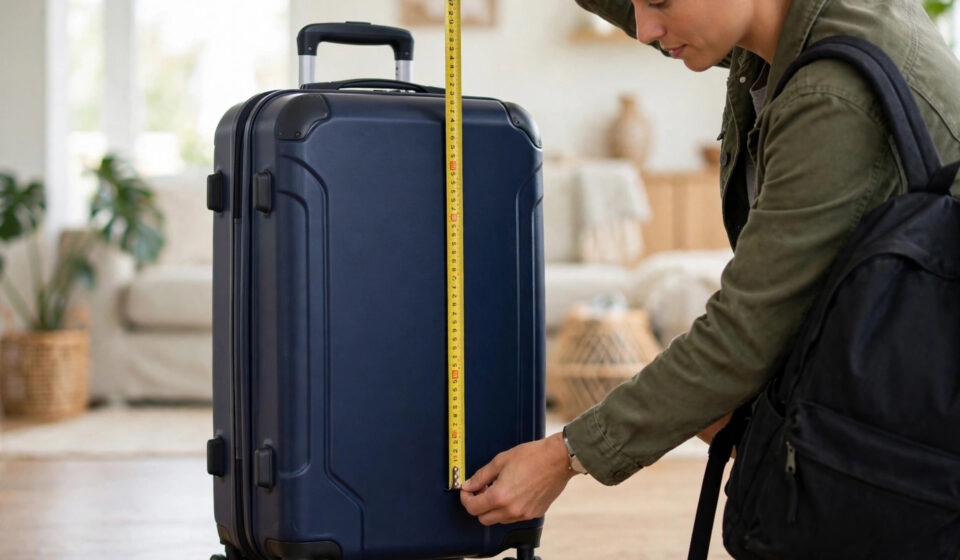
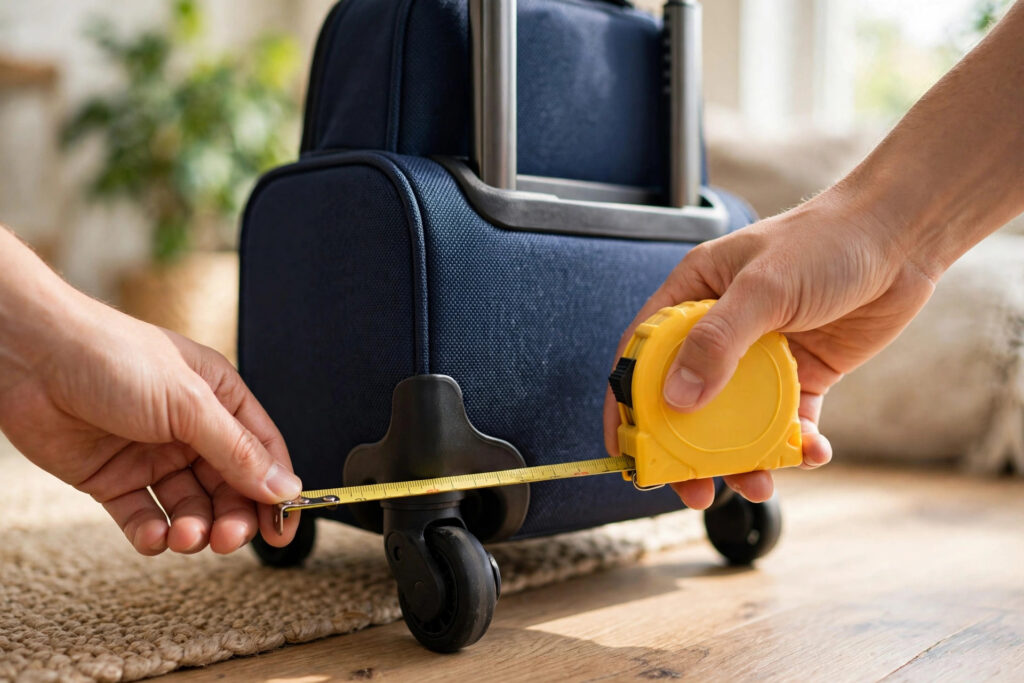
- Stand it upright with wheels down. Measure from the bottom of the wheels to the top of the handle or the highest point of the body, whichever is taller.
- Measure the width at the widest point. Include side handles and any pockets that stick out.
- Measure the depth at the thickest point. Front pockets count. A packed front pocket can add an inch.
- Add the three numbers. The total should be 45 linear inches or less, and no single side should exceed your airline’s listed maximum.
- Weigh the packed bag. Use a luggage scale or a bathroom scale. Even if your airline has no published weight limit, a bag you cannot lift into the overhead bin will draw attention.
Do this once at home and you will never have to guess at the airport.
Hand Carry Weight Limits: US vs International
Here is where US travelers get surprised. Most major US airlines publish no carry-on weight limit at all. Delta, United, and JetBlue focus on size. The informal rule is that you must be able to lift the bag into the overhead bin yourself. International carriers are a different story. Weight limits of 7 to 10 kg (15 to 22 lbs) are typical, and agents actually enforce them, for example Emirates and Qatar Airways around 15 lbs, Ryanair 22 lbs, easyJet 33 lbs, Frontier 35 lbs, British Airways up to 51 lbs. European and Asian budget carriers are the strictest. They routinely weigh bags at check-in or at the gate, and an overweight bag means a fee or a forced check. If you are flying internationally, a lighter bag matters as much as a smaller one.
Why Size Matters At The Gate
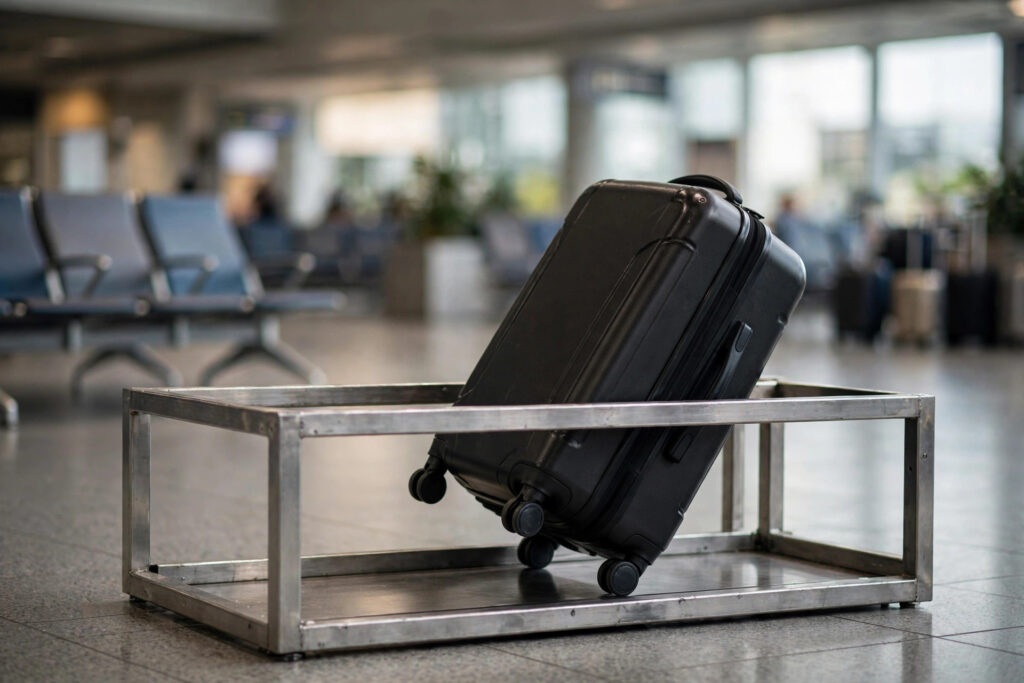
Airlines enforce size rules because overhead bins are shared space with fixed dimensions. When one oversized bag goes in sideways, it eats the space of two or three other bags. That is why enforcement has been getting stricter, with more airlines placing sizer boxes at gates and even before security in 2026. Enforcement style varies by region. At most US airlines it is visual and inconsistent. An agent eyeballs your bag, and if it looks roughly right, you walk on. In Europe and Asia, it is systematic. Budget carriers like Ryanair and easyJet actively direct passengers to the sizer box, and failing the test means paying a gate fee on the spot. A sizer box is a metal or plastic frame that matches the airline’s maximum dimensions. Your bag must slide in easily, with wheels, handles, and all protrusions fitting. Staff will not let you force it. If it does not fit, it does not fly in the cabin.
What Happens If Your Bag Is Oversized
The sequence at the gate is predictable. An agent spots the bag during boarding, asks you to try the sizer, and if it fails, the bag gets gate-checked. That means it goes into the cargo hold and you collect it at baggage claim (or sometimes at the jet bridge on arrival). Two things to know. First, some airlines gate-check for free when the flight is full, but an oversized bag on a strict carrier can trigger a gate fee of up to $100. Second, before you hand the bag over, pull out your valuables, medications, and anything with a lithium battery. Power banks, laptops, and phones must stay in the cabin with you. The FAA is explicit on this. One more scenario: regional jets. Smaller planes have smaller overhead bins. Even a fully compliant 22 x 14 x 9 bag may not fit, and the airline will gate-check it for free. This is normal and not a penalty. If you fly regional routes often, a slightly smaller bag saves you the hassle. There is also a tactic worth knowing: voluntary gate check. On full flights, agents often ask for volunteers to check carry-ons for free before boarding starts. If your bag is borderline and you do not want to risk a fee or a sizer confrontation, volunteering early is the calm way out.
Does A 24-Inch Suitcase Work As Hand Carry?
Usually, no. A 24-inch suitcase exceeds the 22-inch height limit most airlines publish, and in practice it gets treated as checked luggage far more often than as a carry-on. The international standard is even tighter, around 21.5 inches tall. The main exception is Southwest, whose 24 x 16 x 10 limit genuinely fits a 24-inch bag. A few other generous carriers exist. But if you are buying one bag to use across airlines, 22 x 14 x 9 is the safe size.
The Other Hand Carry Limit: Liquids
Size is not the only hand carry restriction. The TSA’s 3-1-1 rule limits liquids, gels, and aerosols in your cabin bag: containers of 3.4 ounces (100 ml) or less, all fitting inside one quart-sized clear bag, one bag per passenger. Toothpaste, shampoo, sunscreen, and even peanut butter count. Anything larger goes in checked luggage. This is another reason to pack hand carry carefully. Solid toiletries like shampoo bars and solid deodorant do not count as liquids at all. For the liquids you do bring, leak-proof travel bottles keep you inside the limit without the mess.
Tips To Stay Within Hand Carry Limits
A few habits make compliance automatic:
- Buy bags marketed as carry-on compliant, then verify with a tape measure anyway. Marketing claims are not airline approvals.
- Watch expandable zippers. An expander adds 1 to 2 inches of depth. If you packed with it open, your bag may no longer qualify.
- Mind the front pocket. It is convenient and it adds depth. Measure with it packed the way you will actually travel.
- Pack suits and business clothes flat on top rather than stuffed in, which keeps the bag’s depth honest.
- Weigh the bag the night before. A cheap luggage scale pays for itself the first time it saves you a gate fee.
The Bottom Line
Hand carry luggage size is simple once you know the numbers: 22 x 14 x 9 inches for most US flights, wheels and handles included, with weight limits that range from “none published” at home to a strict 7 to 10 kg abroad. Measure your bag at home, respect the sizer box, and pull your valuables and batteries before any gate check. For the complete reference across every luggage category and airline type, see our full luggage size chart.