Nine days is the sweet spot for a first trip to Japan. It is enough for the classic Golden Route: Tokyo, Kyoto, and Osaka, with day trips to Mt. Fuji and Nara built in. This 9 day Japan itinerary keeps you in just three bases, so you change hotels only twice in nine days. Every travel day below shows how you get from A to B, how long it takes, and what it typically costs. If you are still choosing which cities to prioritize, read our guide to the best places to visit in Japan first, then come back to this plan.
At-A-Glance: 9 Days, 3 Bases
This table shows the full 9 day Japan itinerary at a glance, with travel times you can plan around.
| Day | Base | Plan | Transit |
|---|---|---|---|
| 1 | Tokyo | Land, settle in, evening walk | Airport to city: typically 40-75 min |
| 2 | Tokyo | Senso-ji, Ueno, Shibuya | Metro only |
| 3 | Tokyo | Mt. Fuji day trip | Round trip: typically 4-5.5 hrs total |
| 4 | Kyoto | Shinkansen to Kyoto, Fushimi Inari | Tokyo to Kyoto: typically ~2h15m |
| 5 | Kyoto | Kiyomizu-dera, Nishiki Market, Gion | Bus/metro |
| 6 | Kyoto | Arashiyama, Kinkaku-ji | Bus/train |
| 7 | Osaka | Nara day trip, move to Osaka | Kyoto to Osaka: typically ~30 min |
| 8 | Osaka | Castle, markets, Shinsekai | Metro only |
| 9 | Home | Souvenirs, fly out of Osaka | City to Kansai Airport: typically 35-55 min |
Before You Go
Book open-jaw flights. Fly into Tokyo (Narita or Haneda) and home from Osaka (Kansai). A round trip through Tokyo forces a half-day Shinkansen ride back at the end. Multi-city tickets usually cost about the same and save you a full travel day.
Do the JR Pass math for your route, do not assume. A 7-day Japan Rail Pass typically costs around 50,000 yen as of 2026, with a scheduled price rise from October 1, 2026. For this itinerary the long-distance legs are only Tokyo to Kyoto and Kyoto to Osaka plus airport trains. Buying single Shinkansen tickets for those legs often costs less than the pass. Add up your actual legs before you buy. If you add day trips like Himeji or Hiroshima, the pass starts to win. Read the details on the official-style guide at japan-guide.com: Japan Rail Pass.
Get an IC card and an eSIM before you land. A Suica or ICOCA card (now on phones too) pays for metros, buses, trains, and even convenience store snacks with one tap. An eSIM with data makes Google Maps your personal tour guide, which matters a lot in Tokyo stations.
Forward your luggage. Japan’s takkyubin luggage-forwarding service sends a suitcase from one hotel to the next overnight for a small fee. Use it when you move Tokyo to Kyoto and Kyoto to Osaka. You will travel hands-free and thank yourself on the train platform.
Carry some cash. Cards work in most city places, but small restaurants, temples, and rural shops still take cash only. A few thousand yen per day per person is a safe buffer. Work through this checklist before your 9 day Japan itinerary begins and the first three days will feel easy.
Day 1: Land in Tokyo, Ease In
Welcome to Japan. Get through immigration, pick up your IC card and eSIM, and head into the city. From Haneda it is typically about 30-40 minutes to central Tokyo; from Narita, typically 60-90 minutes depending on the train. Check in, drop your bags, and take a slow evening walk. Good first-night options: Senso-ji Temple lit up at night in Asakusa, or the Shibuya scramble crossing and its observation deck. Eat somewhere near your hotel. You are tired and jet-lagged; this day is for landing, not sightseeing.
Where to stay in Tokyo: Pick one neighborhood for all three Tokyo nights.
- Asakusa: traditional feel, cheaper hotels, easy airport access, close to Senso-ji. Quieter at night.
- Shinjuku: maximum transit connections, restaurants and nightlife at your door, pricier.
Cut if tired: skip the evening outing entirely. Sleep is the best first-day activity.
Day 2: Classic Tokyo, East to West
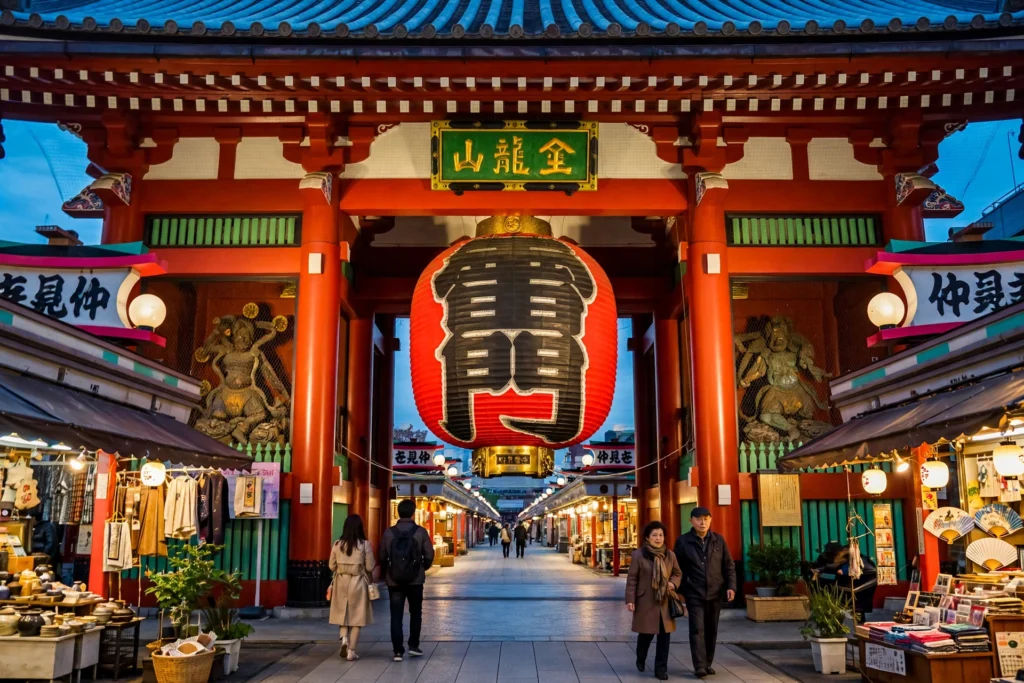
Start early in Asakusa. Senso-ji Temple opens early and the Nakamise shopping street is calm before the crowds. Try a fresh ningyo-yaki cake from a street stall for breakfast.
Head to Ueno next. Ueno Park holds several of Japan’s top museums, and if you want to pick the right ones, see our list of the best museums in Tokyo. The Tokyo National Museum is the flagship for Japanese art and history. Give it two hours; the park itself is a good picnic spot.
In the afternoon, cross town to Harajuku and Meiji Shrine. The shrine’s forested approach feels like a different country from the city outside. Then walk to Shibuya for the crossing, the Hachiko statue, and dinner. Finish with the free observation deck at the Shibuya Sky building if the line is short, or just people-watch from a cafe.
Time budget: Asakusa 2-3 hours, Ueno 2-3 hours, Harajuku/Shibuya 3-4 hours. All by metro, 10-20 minutes between areas.
Cut if tired: drop Ueno museums and keep it a walking day. The shrine and Shibuya are the essentials.
Day 3: Mt. Fuji Day Trip
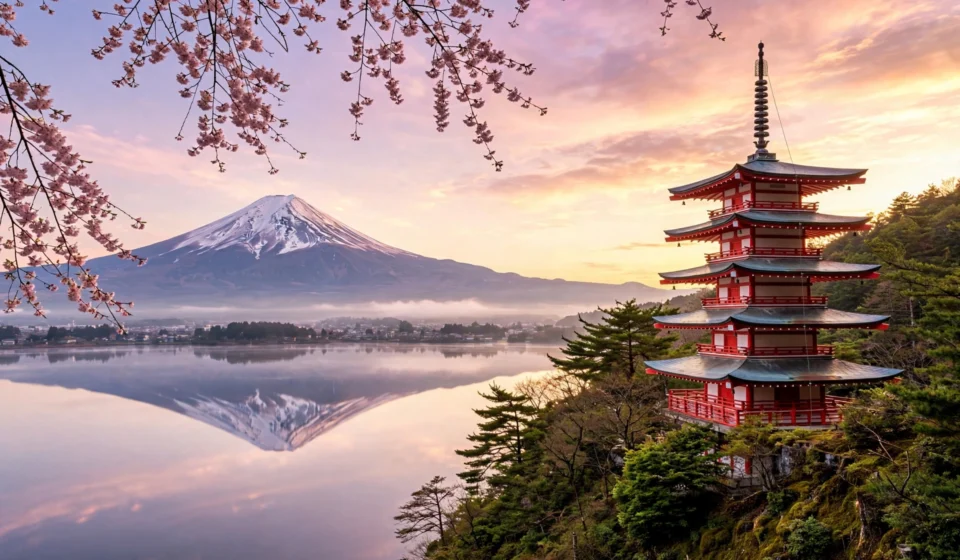
Seeing Mt. Fuji up close is worth one of your nine days, and this 9 day Japan itinerary gives it a full slot. The classic move is the Fuji Five Lakes area around Lake Kawaguchiko. From Shinjuku, the direct limited-express train to Kawaguchiko typically takes just under 2 hours; highway buses take a similar time and cost less.
Do this loop: Chureito Pagoda first (the postcard shot of the pagoda with Fuji behind it, about a 20-minute walk and climb from Shimoyoshida Station), then the lake shore for views and a short walk, then an onsen or foot bath if your legs need it. On clear winter days the mountain is sharp and huge. In summer, haze often hides it, so check the forecast the night before.
Time budget: leave Tokyo by 8 am, back by 6 or 7 pm. Total transit is typically 4-5 hours round trip, leaving 5-6 hours at the lakes.
Cut if tired: swap this for a slow Tokyo day (teamLab Planets in the morning, Yanaka old-town walk in the afternoon). Do not do both; Fuji deserves a full day or none.
Day 4: Tokyo to Kyoto
You are at the halfway point of this 9 day Japan itinerary. Check out, forward your big bag to your Kyoto hotel, and take the Shinkansen from Tokyo Station or Shinagawa.
Transit card: Tokaido Shinkansen, Tokyo to Kyoto. Nozomi trains typically take about 2 hours 15 minutes; Hikari trains take about 2 hours 40 minutes and are the ones most rail passes cover. Sit on the right side (seat D or E) for Fuji views on clear days. For train types and schedules, see japan-guide.com’s Tokaido Shinkansen guide.
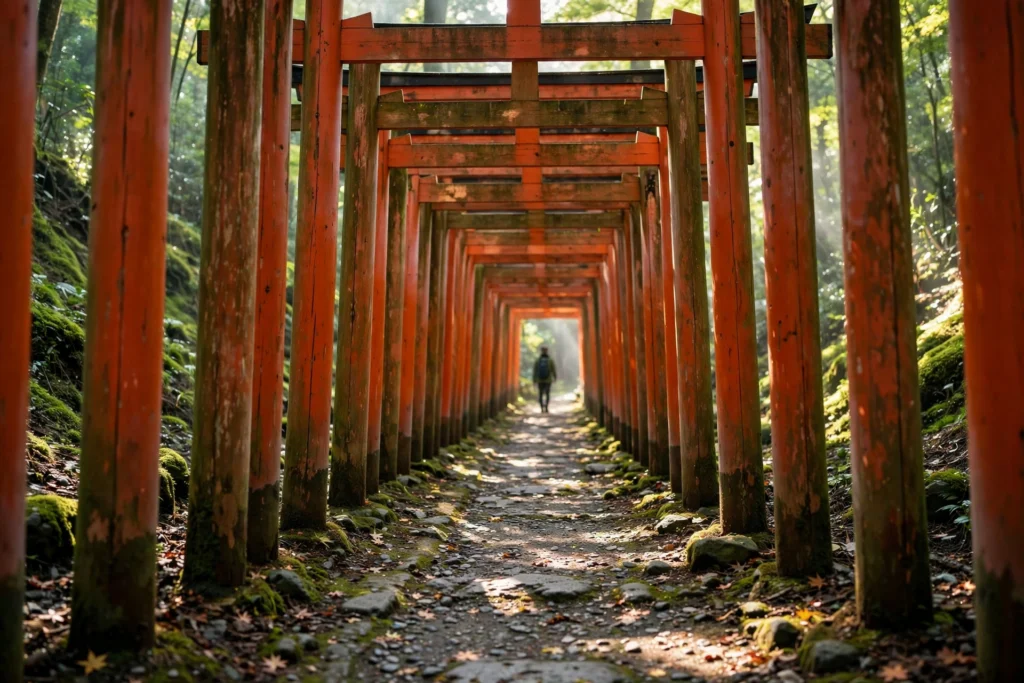
Drop your day bag at the hotel and head straight to Fushimi Inari Taisha. The famous tunnel of red torii gates climbs a mountain, but most people walk the first 30-45 minutes, which covers the best photo spots. Go in the late afternoon when day-trippers leave and the light turns golden.
In the evening, walk Pontocho Alley along the river for dinner. The narrow lane of restaurants and lanterns is Kyoto at its most atmospheric.
Where to stay in Kyoto: one neighborhood for all three Kyoto nights.
- Near Kyoto Station: best for day trips and arrivals, modern hotels, slightly less charming.
- Gion / Higashiyama: traditional streets, machiya townhouses, closer to temples, pricier and trickier with luggage.
Cut if tired: skip the Fushimi climb and just do Pontocho dinner. Fushimi works as a morning visit on Day 5 instead.
Day 5: Kyoto Temples and Old Streets
Start at Kiyomizu-dera, one of Kyoto’s most famous temples. Arrive before 9 am to beat the tour buses. The wooden stage overhanging the hillside gives the classic Kyoto view. Walk down through Sannenzaka and Ninenzaka, preserved streets of old wooden shops, to Yasaka Shrine.
For lunch, go to Nishiki Market, Kyoto’s kitchen. It is a five-block covered arcade of food stalls: tamagoyaki on sticks, fresh tofu donuts, matcha everything. Eat as you walk.
Spend the afternoon however you like: the Philosopher’s Path canal walk is lovely in cherry blossom and fall color seasons, or rest at your hotel.
In the evening, walk through Gion and along the Shirakawa canal. You might spot a geiko (Kyoto’s term for geisha) heading to an appointment. Dinner in Gion, then an early night.
Time budget: Kiyomizu area 3 hours, Nishiki Market 1.5-2 hours, Gion evening 2-3 hours.
Cut if tired: drop the Philosopher’s Path. The morning temples plus the market is a full day.
Day 6: Arashiyama and North Kyoto
Take the train to Arashiyama first thing. The bamboo grove is magical at 8 am and a crowded photo queue by 10. Walk through, then visit Tenryu-ji Temple next door with its famous garden. If you are up for it, the Iwatayama Monkey Park across the river gives skyline views plus macaques.
After lunch, head north to Kinkaku-ji, the Golden Pavilion. It is the single most photographed building in Kyoto, and it earns it. The pavilion covered in gold leaf over a mirror pond is genuinely striking. One loop around the grounds takes about an hour.
Time budget: Arashiyama 3-4 hours, Kinkaku-ji 1.5 hours, transit between them typically 30-45 minutes.
Cut if tired: skip the monkey park climb (it is steep) or swap Kinkaku-ji for the quieter Ryoan-ji rock garden nearby.
Day 7: Nara Day Trip, Then Move to Osaka
Nara is the easiest day trip in this 9 day Japan itinerary, so it pairs perfectly with your move to Osaka. Store your bags or forward them to Osaka, and take the train to Nara. From Kyoto it is typically 45 minutes; from Nara back to Osaka is about the same.
Nara was Japan’s first permanent capital, and its half day of highlights is compact. Todai-ji Temple holds the Great Buddha, one of the largest bronze statues in the world, inside one of the largest wooden buildings. Nara Park around it is full of free-roaming deer. Buy deer crackers from a vendor, but hold them high: the deer bow for food and can get pushy. Finish at Kasuga Taisha shrine with its hundreds of stone lanterns.
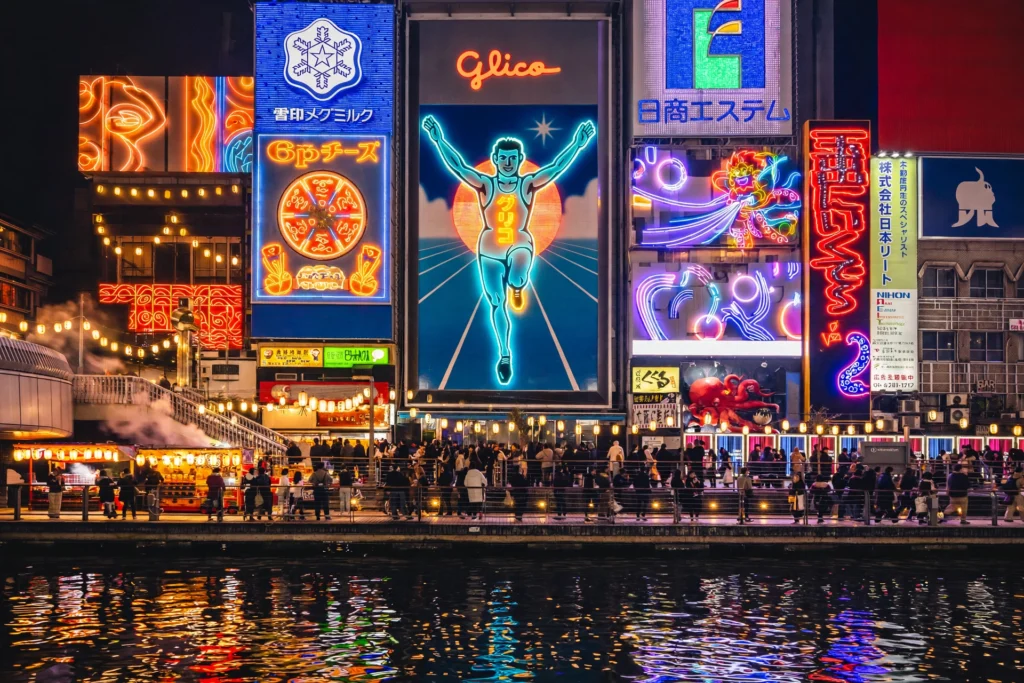
By mid-afternoon, take the train to Osaka and check in. Head to Dotonbori for the evening: the neon canal, the giant Glico running-man sign, and street food. Try takoyaki (octopus balls) and kushikatsu (fried skewers). This is Japan’s kitchen city; come hungry.
Where to stay in Osaka: base yourself in Namba / Shinsaibashi. You are steps from Dotonbori’s food, on multiple metro lines, and close to Kansai airport trains on departure day. See our full breakdown of where to stay in Osaka.
Cut if tired: skip Kasuga Taisha in Nara, or make Nara a half day and rest at the Osaka hotel before dinner.
Day 8: Osaka
Morning at Osaka Castle. The castle tower is a reconstruction with a museum inside, but the stone walls, moat, and park are the real draw. Go early for the best light and smallest crowds.
Walk to Kuromon Market for lunch. Nicknamed Osaka’s kitchen, it is wall-to-wall stalls of grilled seafood, wagyu skewers, and fresh fruit. Then explore Shinsaibashi, the long covered shopping arcade, or cross to Shinsekai, the retro neighborhood under the Tsutenkaku Tower, for old-school Osaka character and cheap kushikatsu.
Alternative: if theme parks are your thing, swap this whole day for Universal Studios Japan. It needs a full day and tickets sell out on weekends, so book ahead. Decide before the trip, not the night before.
Time budget: castle 2-3 hours, Kuromon lunch 1.5 hours, Shinsaibashi/Shinsekai 2-3 hours.
Cut if tired: skip Shinsekai. Castle plus market plus Dotonbori is plenty.
Day 9: Last Morning, Fly Home From Osaka
Sleep in a little. Grab a final konbini breakfast (the egg sandwiches are a cult favorite for a reason) and do last souvenir shopping in Shinsaibashi or at a department store basement food hall.
Transit card: Namba to Kansai International Airport. The Nankai Rapi:t limited express typically takes about 35-40 minutes; the JR Haruka from Tennoji/Shin-Osaka takes a similar time. Leave with at least 3 hours before an international flight.
Sayonara, Japan. You did the Golden Route right: three bases, two hotel moves, no backtracking.
Practical Tips That Save You Real Time
These small habits make any 9 day Japan itinerary run smoother:
- Learn three phrases: sumimasen (excuse me), arigato gozaimasu (thank you), and pointing at the menu works everywhere.
- Eat at off hours. Popular ramen and sushi spots have no line at 11 am or 2 pm and an hour-long line at noon.
- Withdraw cash at 7-Eleven ATMs. They take foreign cards and are everywhere.
- Stand on the correct escalator side. Left in Tokyo, right in Osaka. Locals notice.
- Download offline maps. Station wifi is spotty and you will use maps constantly underground.
Making the Most of Your 9 Days in Japan
This 9 day Japan itinerary gives you Japan’s greatest hits without the exhaustion that ruins so many first trips. Three nights in Tokyo, three in Kyoto, two in Osaka, and day trips to Mt. Fuji and Nara: that is the formula. Book the open-jaw flights, do the rail math, forward your luggage, and keep one “cut if tired” option in your pocket each day. Japan rewards the traveler who slows down enough to notice it.